Thinking Congregations
  • Home
  • Blog
  • Coaching
  • Events
  • About
  • Contact
  • Home
  • Blog
  • Coaching
  • Events
  • About
  • Contact

Clickbait and Congregational Leadership

8/6/2017

2 Comments

 
Picture

This week’s blog post is probably the closest I’ve come to articulating why I get up every morning to write this blog.  I have grown weary of organizations, producing resources for leaders, who offer no evidence that they are helping create resiliency in local congregations.  This is particularly true of online resources.  What’s being offered to clergy and congregational leaders has very little grounding in reality, which begs the question, “why do they keep publishing it and why do we keep reading it?”
 
This problem is not unique to congregations.  Most of the helping professions are stuck in information overload.  There’s a name for it, “Fear of missing out” and the retreats that help people address their “problem” are gaining popularity. 
 
Clergy are not immune from this obsession with information.  Rabbi Ed Friedman was one of the first people I’ve known to liken it to substance abuse.  Clergy and institutional leaders are anxious about the dying church.  As the problem gets worse (and leaders become more anxious), clergy crave resources that offer a promising way forward.  As clergy move from one coveted idea to the next, anxiously working to stem the decline, their anxiety increases with a constant obsession for more ideas.
 
 
The State of Religion
 
There is no doubt in my mind that religious life in the United States is on the decline.  It has been for several decades, and every branch of the religious tree is affected.  Growth does appear in some places on the tree, but it is overshadowed by the vast amount of decline. 
 
I recently read an article confirming that if the current trend in the Christian church continues, membership and average worship attendance will both arrive at “0” in 2040.  That’s a sobering reality!  Will this come true?  It’s hard to say.  It’s unlikely that Christianity will disappear in 23 years, but it will certainly look different! 
 
 
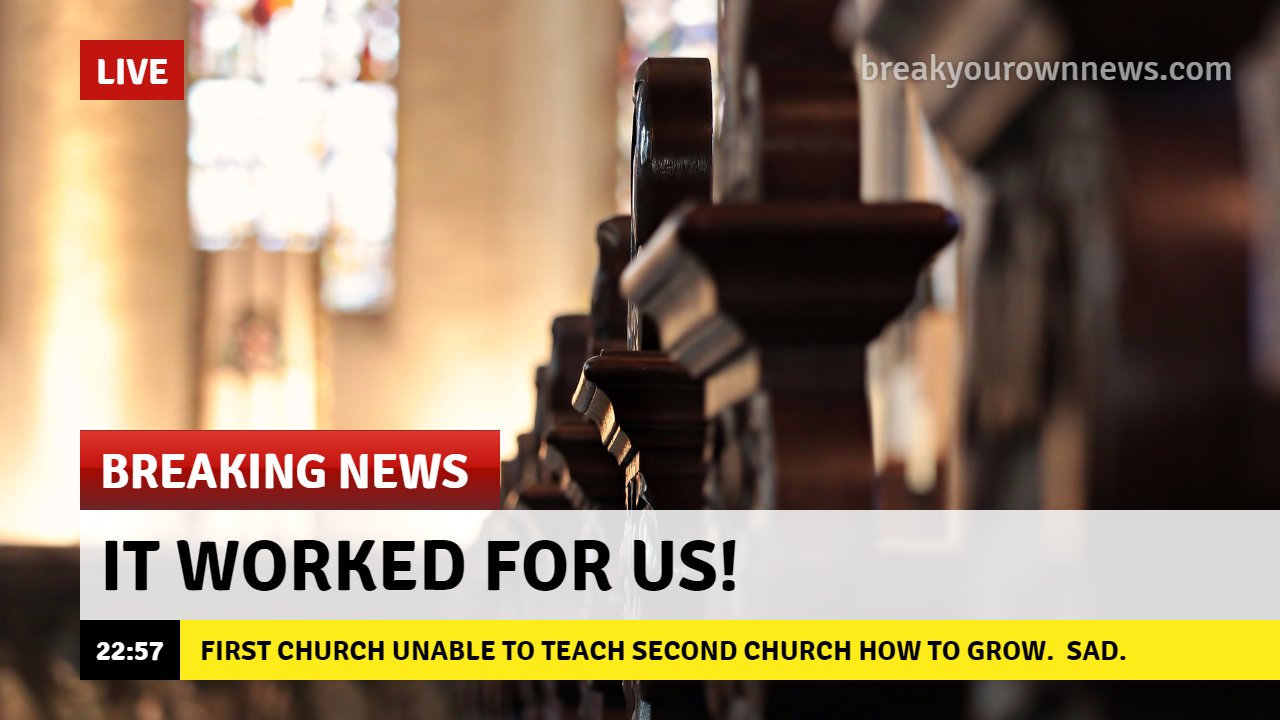
“It Worked for Us” is Insulting
 
I started in full-time ministry 23 years ago.  At the time, I was unaware of the decline in the Christian church.  When I went to college in 1987, Willow Creek had established itself as a pioneer in new church, non-denominational growth.  Things were looking up.  People flocked to Willow Creek both for worship and for leadership training. 
 
It wasn’t long after I began serving in full-time ministry that church officials, pastors, and even lay persons were becoming anxious about declining membership numbers. The factors that contributed to the initial decline in membership created a new level of anxiety for congregational leaders.  But as time went on, that anxiety began to fuel future decline.  The more we worried about decline, the worse it got.  In other words, worry about decline became a self-fulfilled prophecy.
 
The “quick fix” mentality swung into full gear by the late 90’s.  Large congregations, those worshipping above 200, who were experiencing significant success in membership growth, started to charge smaller congregations (many who were being pressured by judicatory leaders to address the decline) a fee to come and learn “what worked” for them.  The teaching was done with good intentions.  The result?  None of it was transferable.  The learnings from the larger congregations did not translate well to the smaller congregations.  There may have been a few exceptions to this, but on the whole, nothing changed.  Despite all of the teaching on best practices, the mainline church continued to decline and has yet to level off.  We are closer than ever to the brink of extinction, and yet we continue to push the same paradigm, hoping things will change.    
 
 
Clickbait for Congregations
 
Most leadership institutions for clergy are intellectually lazy.  Desperate to hold your attention and provide something of substance, they look for any congregation anywhere that has any kind of success which is then offered up as a possible new model.  I recently read one such article that pointed to church growth for a couple of congregations that moved their main worship from Sunday morning to Wednesday evening.  As if that’s the key.  While I don’t dispute the examples that were given, correlation does not equal causation. 
 
I don’t doubt that these organizations are publishing these ideas with the best of intentions.  They may even offer them with the hope that it will inspire creativity, thinking outside of the box, and perhaps throw open the flood gates of new ideas.  Is it any wonder that we are in decline as pastors continue to implement any idea that looks remotely promising?  And then we wonder why it is so difficult to find volunteers.  This process is exhausting!
 
If I’m going to move my worship services from Sunday to Wednesday, I want to know some specifics.  I want to know success rates.  I want to know about as many variables as possible.  I want to know something about the churches that had success.  Tell me about the functional level of the person leading the effort to change.  Tell me about the functional level of the congregation and its leaders.  Tell me about their track record in making these types of changes.  Tell me about the process they used to make the change.  Tell me about the resources that were available to them.  Tell me how they handled the predictable pushback.  Tell me about the effects of the change on the growth of the congregation one year out and five years out.  Was it worth it and how did they measure it?
 
Church growth coaches and educators simply offer a glowing review of a congregation’s success without any relevant, factual data about the total effort that went into making the change.  No one seems to be capturing the entirety of the markers of the process that led to success.
 
I call this effort (to only publish the results and not the process) “clickbait” because church growth organizations are giving into the temptation to use catchy headlines and engaging subtitles to attract desperate pastors and congregational leaders who will try anything once to calm their anxiety.
 
 
The Answer is Thinking!
 
Don’t be conformed to the patterns of this world, but be transformed by the renewing of your minds so that you can figure out what God’s will is—what is good and pleasing and mature.  Romans 12:2 (CEB).  What’s important to me is not the results of the effort, but the process that went into the effort.  What do successful leaders think about at each milestone of congregational growth?  What’s on their mind? How are their minds being transformed?  How are the minds of the congregation being transformed?  Did they ever catch a break that helped them make it to the next level?
 
I’ve never interviewed a successful pastor, something I would love to do, but this is what I would guess they think about:

  1. What is the context of my congregation?  Where is it located?  Who is attending?  Who is not attending?  What is the nature of the community I’m serving? What is the congregation’s historical connection with the community?  How connected is the congregation to the community?
  2. What is the functional level of the congregation?  How well do they do when challenged?  How well do the leaders function?  How tense are the relationships in the congregation?  How do they process anxiety?  Who needs to stay in leadership, and who needs to rotate out?
  3. How am I reacting to the congregation?  Am I stressed and anxious about the congregation or am I confident about the future?  To what extent am I able to step back and think about the challenges the congregation is facing?  What will it take for me to be a better leader?  What will it take for me to be emotionally neutral (not take sides or blame others or self) in my relationship with each person in this congregation?  What am I willing to tolerate?  What am I not willing to tolerate?  What is this congregation capable of achieving?  What am I capable of achieving?
  4. Who are the people in the congregation who are motivated to be the best version of themselves?  Who is as invested in their life as they are in the life of the congregation?  Who are the most mature, responsible individuals in the congregation?  What will it take to get them engaged?  What is the best way to challenge them?
  5. What is the identity of this congregation?  What is the congregation hoping to accomplish down the road?
  6. What are the steps that will lead to implementing the vision?  What will it require of the congregation?  What resources are available to do this work and what resources are needed?  Who has the capacity to make this happen?
 
As you can tell, it’s not sexy.  It’s not something that can fit into a headline nor catch your attention in five to seven words. It’s not a quick fix, and it’s certainly not something you can learn in an all-day training, over a weakened, or even at a week-long event.  It takes a consistent, persistent effort over time.  There are no shortcuts. 
 
To be clear, there is a time and a place for resourcing and training congregational leaders.  I do it, others do it, and it’s important.  But the focus of training needs to shift radically from programs and ideas to thinking and process.  Once the thinking and process are engaged with lower levels of anxiety, programs and ideas will follow.
 
Who is training congregational leaders to do this work?  What seminaries teach these types of skills?  What “teaching congregations” are offering these types of classes?  What institutes are promoting differentiation of self?  The answers? Very few.  Why?  Because, on the whole, denominational leaders have yet to admit that the current paradigm for training no longer works.  The organizations that resource local congregations are so reactive to our current plight, they seem to lack the capacity to redirect their efforts and pull up. 
 
It’s possible that even the best leaders we have are not aware how they perpetuate the challenges we face.  They may be so focused on the content of solutions that they too are missing how a focus on thinking and process can solve these challenges.  Congregations succeed not because of the programs, content, or techniques of a specific model.  They succeed because of the resiliency of the relationship system in the church and the process that goes into creating a vibrant congregation.  It is fundamentally about the relationship system whether we’re talking about the congregation, the family, the neighborhood, the community, or society in general.  The sooner we embrace this reality and train congregational leaders to engage their thinking in the context of the relationship system, the better chance we have of transforming ourselves and local congregations.

2 Comments

Thinking for Self: Lessons from Protestant History

7/15/2017

0 Comments

 
Picture

The Gutenberg Bible changed the trajectory of Christianity forever.  Before its creation in the 1450’s, the Bible had been painstakingly written by hand.  Jerome’s Vulgate edition was the official translation for many years and the one Johannes Gutenberg used for the first printed edition.
 
Before the Gutenberg Bible, because Bibles were handwritten, they were rare.  Most people heard the Bible read during worship.  While Christianity had spread throughout most of Europe by the 1400’s, the Bible remained in one language, Latin; a language that worshipers did not know.  They would hear the Latin translation spoken in worship, but were dependent on an interpreter (a local priest) to translate the text into a native language. 
 
When Martin Luther publicly declared his Disputation on the Power and Efficacy of Indulgences, questioning and debating beliefs of the Catholic Church (and subsequently launching what would become known as the Lutheran Church), he took advantage of the printing press.  He began making the Bible available in the vernacular of his day, German.  The Bible became an accessible book that everyone could understand.  A human mediator was no longer necessary.
 
 
Divine Revelation and Thinking for Self
 
For Luther, the individual did not require an intermediator between themselves and God.  In catholic thinking, clergy played a central role in offering prayers on behalf of the people, hearing confessions, offering forgiveness, and instructing individuals in having a right relationship with God through actions like penance and indulgences.
 
I’m not a Lutheran scholar by any stretch of the imagination, but I do know that this fundamental shift away from an intermediator set the stage for subsequent church splits.  Individualism would become a driving force in the diversification of the church.  And by individualism, I don’t mean the rugged idea that most American’s have.  I mean the way an individual reacts and rebels against the natural tendencies of the human to be in community with others.
 
When congregations or denominations disagreed about belief and practice, it often results in some form of a split.  All Protestant denominations have their roots in a church split.  The narrative is always the same: one group of people, believing they have a divine revelation, stands up and against another group.  This first group will argue and debate their point.  If the two groups become polarized, one group will leave.  They will base the decision to leave on their personal relationship with God.  They will blame the other and accuse the other of being irrational, mean, judgmental, intolerant, and wrong.  The problem is in the narrative.  It's misleading.  While it makes sense to those who are leaving, it misses something much more powerful: any church split is the result of a relationship process, what Dr. Murray Bowen called an emotional process.
 
 
The Role of an Emotional Process
 

One of the goals in faith formation is aligning behavior with belief.  This is the role of clergy: teaching people how belief influences practice and how practice influences belief.  But clergy are no different than anyone else.  They too struggle with this process of lining up what they say and what they do. 
 
For example, some Protestant clergy believe that one way to develop a relationship with God is simply to take a Bible and read it (an idea that has its roots in the reformation).  By merely reading the Bible, God’s presence can become known, and one can have a personal experience of God.  Makes sense.  But what happens if the experience of God is outside the accepted theological framework of one’s particular expression of faith?  In most cases, clergy are quick to accuse someone of heresy.  This, then, is the history of Christianity since Luther.  We encourage individuals to discover and explore faith, but only if it is within the confines of a particular faith tradition.
 
Congregations and denominations fall on a continuum between two polarizing positions.  At one end of the continuum are congregations or denominations who stand firm in a traditional view of the scriptures.  How far back one goes to determine this traditional view will vary from group to group.  Any beliefs that are outside of this view are labeled heretical.  There was a time in our history when heretical views would get you killed.  Today’s church has taken a more civilized tone.  Heretical beliefs will simply land you in hell for all of eternity.    
 
On the other end of this continuum are individuals who challenge traditional views and eventually leave the church to practice their beliefs.  But we are social creatures.  So, it is difficult to tolerate being alone in one’s beliefs for any extended length of time.  People who leave a church will eventually find like-minded individuals to join or form a congregation.  And, of course, these congregations develop their own traditional views of scriptures, setting the stage for future generations to repeat the process.
 
What remains to be seen is whether humans have the capacity to stay connected with a congregation while maintaining different beliefs and practices.  It’s easy to be caught up in the effort of beliefs and practices and miss the emotional process.  This is the classic content vs. process problem.  The threshold for developing this capacity is not in the variety of beliefs and practices that exist in a congregation or denomination but on the quality of the relationships of the people.  You can have a group whose beliefs and practices are identical but have a tense and anxious relationship system.  You can also have a group with a wide variety of beliefs and practices who also are tense and anxious as a group.  For example, in a congregation, people may be free to believe and practice as they wish but huge fights break out over the leadership ability and style of the pastor, or the way the finances are being managed. 

These same struggles begin in the family.  Those who struggle to work out differences in a congregation, more than likely have a difficult time working out differences in their families.   So, you can have families where everyone agrees but only because disagreement creates too much tension and unease in the family.  You can also have families were everyone disagrees, but the disagreement serves as a way to keep others at a distance.  

 
Establishing Opportunities for Thinking for Self
 
First confession.  I’m a United Methodist pastor who believes in and practices the core beliefs of the church.  I, like everyone else, experience times of doubt where I question and reconsider what I believe.  There are days ("momma said there'll be days like this") when I doubt the Methodist Way.  Even now, our denomination is on the verge of a split over our beliefs and practices.  It seems unlikely that we will continue to stay connected amid our differences.  Each side wants the other side to change.  It’s an indicator of our denomination’s level of functioning.
 
My second confession (there are only two).  What I’ve articulated in this post is theoretical.  I have yet to find a congregation who is completely diverse in beliefs and practices, and respects each other.  I’ve read articles about congregations who have developed interfaith sites.  These congregations remain separate, but the effort is there.  If you know of a place, please share it in the comment section below.  Most congregations vary in their ability to do this, but currently it is always within an established boundary of beliefs.  The forces for togetherness still outweigh the forces for individuality.  
 
The test of any congregation is, theoretically, the ability of leaders to tell the difference between thinking that is based on well thought out principles and thinking that is based on relationship needs.  Dr. Murray Bowen categorized these two ways of thinking as solid self and pseudo self.  Solid self comes out of one’s effort to intentionally sit down (lets say with paper and pen) and work on gaining clarity about what one “knows” about life based on facts.  Most people (if they put in the time) have the capacity to articulate three or four core beliefs, which they can use at any moment and in any situation, to help them navigate an anxious situation.  Pseudo self is based on thinking that is borrowed from someone else, typically other family members.  We may blindly accept what someone else believes and latch onto it.  But in the words of Rev. Robert Williamson, these beliefs are more “brittle.”  When anxiety goes up, they do not provide a solid place to stand. 
 
The solution is simple, but the implementation is a challenge.  Theoretically, what’s needed are opportunities for individuals to work on establishing their core beliefs.  These core beliefs are the bedrock for functioning because they help one not only navigate difficult situations but also help one stay connected in important relationships, even if others hold different beliefs and practices.  It's counterintuitive: working on self helps one be better connected to important others.  Working on differentiation of self helps one do a better job of balancing individuality and togetherness.  
 
This raises lots of questions which still need to be answered.  What is a community?  What are the markers?  How much can a faith community tolerate regarding different beliefs and practices?  How do you define community if individuals have different beliefs and practices?  Is this even a possibility?  If not, in what ways can communities that have different beliefs and practices stay connected?  What is lost and gained by this process?  I hope you will add your thinking in the comment section below. 
0 Comments

Clergy Consultation Group

7/8/2017

2 Comments

 
Picture

​Let’s be honest.  Nothing is working like it used to.  In the Christian faith, clergy and their supervisors are desperate to get people back into worship.  A little history might be useful.
 
I went to college in the late 80’s, and after discerning a call to ministry, I headed right to seminary.  While I was in school for those seven years, "church" began to look different; reflecting some of the cultural changes that started in the 60’s and 70’s.
 
One example is contemporary worship.  Thanks to the glorious success of places like Willow Creek, baby boomers were flocking to contemporary services.  My training in contemporary worship came, not in seminary, but later while serving a congregation who took up an interest in it.  I have nothing against my formal training.  Most of it was good. 
 
Around the time I graduated seminary, denominational leaders were starting to wake up to the fact that declining membership numbers were not turning around.  The solution was to introduce every four years a new conference-wide program to address the decline.  In fact, I can’t remember at a time in my career that we weren’t trying to address the decline.    
 
As far as I can tell, the response has been rooted in anxiety; a fear based response.  It’s difficult to know what is driving the decline today: shifting cultural dynamics, or an anxious church.  There is a difference.  The former is a problem to be solved.  The latter is a self-fulling prophesy.  Anxiety has a way of making our perceived fears come true. 
 
Our inability to reverse the decline has not been from a lack of trying.  My goodness!  We have tried all kinds of things.  We brought in this consultant, and that consultant, and introduced this program, and that program, and offered this training, and that training.  There was a time when local congregations could make money if they were attracting new members.  If a congregation was having success, they simply organized a conference on site and congregations from all over the world would flock to find out how they did it.  While there are a few places that continue to offer this model of "what works for us", it does not work for everyone else.
 
The problem was implementation.  You can’t take what works in one congregation and transfer it to another.  The ideas and concepts did transfer, but the results did not.  This approach had its roots in the franchise business model.  Not unlike McDonald's where you can set up a franchise anywhere and guaranty customers the same experience and results in every location.  The latest craze is the satellite church model where you try to reproduce what you do in multiple sights.  This works if everyone is being directed by the mother ship.   And, to be fair, while those who lead the training I attended over the years never explicitly said they wanted us to reproduce their success, those who attended did make a go of it.  

The effort to embrace developing business models geared towards consumerism missed the fact that our biggest commodity is relationships.  What every congregation offers is a transformed life rooted in relationships.  In our pursuit of anything that will work, we were blind to the relationship process of human behavior and failed to train our leaders in the developing, scientific research.  We weren't able to see at the time that the content we were trying to implement was being undermined by an emotional process.
 
After completing seminary, I was excited to be ordained and felt ready to lead and develop congregational life.  I began introducing new ideas and worked to foster creativity in the congregation.  It became clear that I was spending more time addressing challenging behavior then I was implementing new ideas.  It was as if there was a connection between my pursuit of implementing change through new ideas and the reactivity I received from certain members of the congregation.  I was clearly missing something, and I needed a framework for thinking about it.
 
I attended a conference back in the mid 90’s that helped me transform my leadership.  The presenter said, “Good leadership rises above the anxiety of the group.”  I’ll never forget it.  I wrote that sentence down and taped it to the dashboard of my car!  That presenter was Rev. Peter Steinke and what he was teaching was a systems model of human behavior.  It had its roots in Bowen Family Systems Theory.
 
Bowen Theory (its shorter title) is a theory of human behavior.  The concepts are based on the family as an emotional unit.  Each person plays their part, but the family operates as a whole.  If you want to understand the behavior of one person, you look at the relationship system.  People like Pete, who studied Dr. Murray Bowen's ideas, began to realize that the same concepts that applied to families applied to other relationship systems, like the church (which is usually made up of families).  Sometimes the problems people are having with family members spill over to their relationships in the church, or the school, or the government, or any other social agency.  Leaders of these institutions become the lightning rod of an anxious, relationship process.
 
I’ve spent almost 20 years researching Bowen Family Systems Theory.  For me, it provides a way to think about congregations.  It just makes sense.  If the church is ever going to be vibrant, it will need to think systems.  Understanding behavior in the context of relationship systems is what leaders will need to do to be successful in their calling.  So, instead of complaining about the state of the church and the decline of mainline congregations, I decided to do something about it.
 
For the past two years, I’ve offered a program called Clergy Consultation Group.    Once a month I teach the basic concepts of Bowen Theory and help participants learn how to apply it to the congregation, and yes, even the family. 
 
This fall I will be offering the program again.  This time, I’m excited to announce that there will be two options: an in-person option and, new this year, an online option.  In both options, the program is offered for 2 ½ hours once a month.  Most of the time is spent with me teaching one of the eight concepts of Bowen Theory.  Each month, one participant will have the opportunity to apply the theory either to their congregation or family. 
 
What can you hope to gain from this program?  The answer comes from Dr. Murray Bowen who developed the theory.  I’ve reworked the word "family" and applied the quote to congregations.  The meaning remains:
 
A congregational leader is someone who has “the courage to define self, who is invested in the welfare of the [congregation] as in self, who is neither angry or dogmatic, whose energy goes to changing self rather than telling others what they should do, who can know and respect the multiple opinions of others, who can modify self in response to the strengths of the group, and who is not influenced by the irresponsible opinions of others. . . [A leader] automatically generates mature leadership qualities in other[s] who are to follow.” Family Evaluation, 342-3
 
To register for the Clergy Consultation Group or to learn more, go to https://www.thecenterforfamilyconsultation.com/programs/clergy-consultation-group/
2 Comments

The Thinking Congregation

2/5/2017

2 Comments

 
Picture

In theory, congregations have the capacity to be a positive influence on the broader community.  They have a belief system that often looks at the big picture, a narrative that upholds the respect and sanctity of life, and, for some, a relationship system that treats people as equals.
 
In practice, congregations are becoming just the opposite.  They are narrowing their beliefs, touting theological positions that only serve to counter secular ideals, promoting a narrative of taking a life to “save” lives, and treating people who are different, differently.  It’s observable in meetings, and in emails and phone calls between parishioners.  Is it realistic to expect congregations to behave any different than those who do not attend a congregation?
 
For mainline Protestant denominations, there has been a steady decline in worship attendance over the past fifty years.  A benchmark denomination, the Southern Baptist Convention, is addressing decline for the first time in its history.  What contributes to this mass exodus from the mainline church?  It is not a failure to communicate the message.  It is not a lack of effort.  The decline is related to the inability of local congregations to be flexible and adaptable to the rising tide of societal anxiety. 
 
I’ve assembled some ideas on what this looks like in relationship to ministries of outreach, nurture, and administration.
 
 
Outreach and Missions
 
Most congregations participate in some form of outreach.  And when I say outreach, I mean ministries with the poor.  Congregations often send money and volunteers to local agencies.  Many of these agencies are coming to terms with how traditional paradigms for helping the poor are not working.  Good intentions to help individuals who are in need have promoted a type of helplessness.
 
Dr. Murray Bowen describes a projection process that goes on in the family that extends to the helping professionals:
 
“The family projection process is a triangular emotional process through which two powerful people in the triangle reduce their own anxiety and insecurity by picking a defect in the third person, diagnosing and confirming the defect as pitiful and in need of benevolent attention, and then ministering to the pitiful helpless one, which results in the week becoming weaker and the strong becoming stronger.  It is present in all people to some degree, and by overcompassion in poorly integrated, overemotional people, powered by benevolent overhelpfulness that benefits the stronger one more than the recipient, and is justified in the name of goodness and self-sacrificing righteousness.  The prevalence of the process in society would suggest that more hurtfulness to others is done in the service of pious helpfulness than in the name of malevolent intent.”  Family Therapy in Clinical Practice, p 434. 
 
The time has come for congregations to step up their understanding of emotional process as it relates to outreach ministries.  This includes finding new ways of engaging others in need without contributing to their underfunctioning.  Congregations need to start asking the question, “When is helping not helping?”
 
 
Education and Programming
 
Fear stunts our intellectual growth.  Our motivation to uncover facts, our drive to discover, and our curiosity for exploration are halted by fear.  If not challenged, our fears will keep us from learning and growing.  We will lack the confidence to move forward.
 
What does it mean to be challenged?  A great coach is someone who knows how to challenge an individual to reach beyond their capacity.  They bring out the best in their student.
 
Where in your congregation are people being challenged?  How are these challenges tailored to the individual and not generalized to an entire congregation?  Who are the coaches working to challenge others to reach past their potential?  Where are the leadership development programs that encourage people to step up and do better? 
 
 
Administration
 
Congregations are anxious about administration.  Most congregations first fill their administrative vacancies leaving programs to suffer from a lack of leadership and volunteers.  It says something about the level of anxiety people have about administration, especially finances.
 
All congregations need to be transparent in the ways they handle finance.  Unfortunately, congregational leaders are often transparent in the wrong ways.  Instead of being transparent about the facts of their financials, they are transparent about their anxiety.  They share their worries and fears either by withholding information or fantasizing about the future demise of the congregation.
 
Leaders do a better job with finances when they find ways to share facts and decrease the amount of anxiety they share.  It’s useful to focus less on telling the congregation what to do (like how much people should give) and focus more on encouraging individuals to be responsible givers.  When leaders talk about the impact of giving on the ministries of the congregation and the community, those are facts.  It is not a fact to tell the congregation you will turn off the lights in worship if the giving does not increase.  Efforts to blame or shame have no place in congregations or any relationship system. 
 
Does your congregation help people learn about personal finances?  Does your congregation offer opportunities for people to think about what kind of legacy they want to leave and how they will support ministries and organizations to that end?  Do leaders work to understand the goals of individual members and think with them about how to accomplish their goals?  Do leaders model this effort themselves? 
 
 
What is responsible leadership?
 
It’s important for congregational leaders to define what they believe, what is important to them, and what they are trying to accomplish in their life.
 
Dr. Bowen developed a view of what he called the “family leader.”  Therapy for Bowen involved identifying someone in the family with the capacity to be more of a self; someone who is actively working on differentiation of self.  He writes:
 
“Operationally, ideal family treatment begins when one can find a family leader with the courage to define self, who is as invested in the welfare of the family as in self, who is neither angry nor dogmatic, whose energy goes to changing self rather than telling others what they should do, who can know and respect the multiple opinions of others, who can modify self in response to the strengths of the group, and who is not influenced by the irresponsible opinions of others . . . A family leader is beyond the popular notion of power.  A responsible family leader automatically generates mature leadership qualities in other family members who are to follow.” (Kerr and Bowen 1988, 342-43)
 
A responsible leader is someone who is working on being their best self.  It is what Bowen described as differentiation of self.  It is a thinker – someone who thinks systems.  Someone who is focused on “I” while others are focused on “we.”  It is a connected self.  Someone who has viable contact with both their family relationship system and the congregational relationship system while working on self-regulation.  It is charting one’s own course while respecting the courses others are taking.  It is acting on one’s beliefs and being prepared for the reactivity from others that inevitably accompanies such an effort.  It is understanding that everyone is doing the best they can with what they have.  But we can all do better.
To learn more about coaching or to invite John Bell to speak to your leadership team or group, go to the contact page by clicking here.
Want to receive this weekly blog straight to your inbox every Monday morning?  Subscribe by clicking here!
2 Comments

Outsourcing

10/16/2016

2 Comments

 
Picture
Everyone agrees congregations no longer enjoy a prominence in the United States.  However, no one can agree on why this is.  Countless books and blogs like this one have attempted to answer this question.  After forty plus years of research and reflection, we still don’t have an answer.
 
 
The numbers don’t lie.
 
Researchers like the Pew Research Center have documented the continued decline of mainline Protestant congregations.  Over the years, the indicator of congregational health and growth has been the Southern Baptist Convention.  While most denominations were in decline, the SBC was showing growth.  But not anymore.  Even after embracing a more diverse demographic, the SBC is now in decline. 
 
People are still hungry for the things that congregations have historically offered.  Now, outside organizations are offering the same experience once unique to congregations.  I call this phenomenon “outsourcing.”
 
Congregations first felt the pinch of outsourcing when annual giving declined.  The reason?  Not-for-profit organizations began sprouting up everywhere to offer relief for social issues once provided by congregations.  As these organizations matured, they became more effective and efficient at both providing relief and marketing their efforts to a broader donor base.  Congregations would soon be competing for dollars with these more sophisticated agencies.  Today, congregations provide a significant volunteer base to the very organizations that are competing with them for donor dollars. 
 
Opportunities for social gathering have been outsourced.  Those who are lifelong members of a congregation can recall a time when large numbers of people from the community attended services.  Some congregations were a “who’s who” of community life.  While some congregations, particularly those in rural communities and in southern states, are still the social center of everyday life, most people get their fix for social connections in other places.  Travel groups, children’s sports clubs and booster programs, and networking organizations like Kiwanis and Rotary (even though these clubs are also seeing marked declines) are all providing a place for social connections.
 
Worship has been outsourced as well.  I recently read about an organization that invites people to sing classic choral pieces in four part harmonies.  The organization travels around the United States, renting out large auditoriums and charging singers admission.  It used to be that individuals joined church choirs to fulfill their love of singing.  Even preaching has been outsourced.  Shows like The Moth Radio Hour consists of a handful of individuals competing to tell the most hope-filled stories in under six minutes.  These events are typically sold-out.
 
 
The reaction to these trends has been strong and varied.
 
For some, the decline of the congregation reveals how, more than ever, their congregation needs to ramp up the promotion of their ideology into the broader culture.  They continue to push beliefs and programs hoping that whatever internal changes they agree to make will attract the “nones” (those with no religious affiliation).  They continue this approach, often unwilling to make strategic changes until only a handful of people remain.  These congregations continue to see the problem outside of themselves in the values of the broader community.  The people outside of the congregation are the ones who need to change and their congregation is ready and waiting for them to come through the doors.
 
For some, the decline points to an unwillingness of the congregation to let go of the past.  The congregation is then engaged in the process of a major, strategic overhaul to find new ways to communicate their ideology in even more hip and relevant ways.  They are in a constant state of flux as they continually piggyback on whatever trendy thing comes along.  Over time it becomes difficult to sustain this effort without shifting the normative values of the congregation.  As a result, the core base of the church starts to leave.  The problem is viewed as internal.  It is the congregation that needs to change.
 
 
The real issue is fear.
 
Peter Steinke wrote several books for his series Health Congregations.  A major theme in his writings is how relationship systems react to anxiety.  He identifies five outcomes:  Reactivity, herding, blaming, quick-fix mentality, and poorly defined leadership. 
 
Reactivity reflects our tendency to take things personally instead of seeing behavior as part of a broader system.  Herding is the polarization of people that occurs as a result of an increased response to fear.  Blaming is an effort to identify our own internal discomfort and then make someone else responsible for it.  A quick-fix mentality is having short-term solutions to resolve congregational anxiety at the expense of long-term gains.  Poorly defined leadership reflects a tendency to elect or appoint immature leaders who are unable to define a self and are vulnerable to setting agendas that only address anxiety in the relationship system.
 
These are fear-based reactions.  Regardless of what started the initial decline many years ago, the fact that it has continued confirms the idea: congregations are approaching decline out of a fear based response.  The evidence is observable when looking at Steinke’s five behavioral responses. 
 
Take, for example, the quick-fix mentality.  Since the early 1990’s, the denominational conference that ordained me has initiated a new church growth strategy about every four years.  These are programmatic initiatives focused on identifying congregational weaknesses and flaws.  Training is provided by the conference to help congregations overcome their deficiencies.  I’m not aware of any research that has been done to evaluate the success of these programs.  My hunch is the outcomes varied from church to church.  Some responded well and successfully implemented the training ideas.  Others were unable to make the necessary changes, and the ideas from the training became a source of conflict for the congregation.  This would be evidence of a fear-based response.
 
 
Thinking congregations focus on relationships and not programs.
 
Denominations and local congregations continue to pour money and time into trainings that offer quick-fixes and identify problematic behaviors.  That horse is dead, and yet we continue to use this methodology to pull congregations forward.  No program is going to solve the problems congregational leaders are facing today.  A concrete list of ideas to save a congregation from decline does not exist and anyone who tries to sell you one is a charlatan.  Why?  Because programs and initiatives that fail to address problems in the relationship system are doomed to fail. 
 
The reason so many programs that were the bread and butter of congregational life are being outsourced is that they remove the very thing that continues to be problematic for congregations: an anxious relationship system.  One can sing in a giant concert hall for an afternoon filled with hundreds of other singers . . . and then go home.  You don’t have to deal with all the other alto’s week in and week out.  You can plug in and then plug out.  There is no messy relationship system.  If you meet someone you like, you can start a friendship.  If not, you’ve had a lovely afternoon singing. 
 
One can volunteer at a local relief organization and put dehydrated soy products in a sealed bag to be shipped across the world without ever having to attend a monthly meeting listening to people complain about institutional problems.  Parents are willing to sign up to bring drinks, supplies, and even volunteer for a day in their kid’s classroom, but please don’t ask them to serve as an officer for the parent organization.  Our sensitivity to others continues to increase. 
 
As anxiety increases and we become more sensitive to others in the family relationship system, the anxiety spills over into the broader society and into other systems like schools, courts, and governments.  As these systems experience increased anxiety from families, they push back to the family creating more and more anxiety.  Ending this cycle of anxiety requires individual leaders who can take responsibility for their reactivity.  You can read more about the societal emotional process developed by Dr. Murray Bowen by clicking here. 
 
 
Bringing programs back.
 
Congregations are not intentionally outsourcing their programs to external organizations.  The growth of these programs is related to the inability of congregations to address the underlying relationship problems.  Let me be clear; these problems are not unique to congregations.  All organizations that have a large relationship component are facing the same challenge.  If congregations are going to reclaim an important role in society, the first step is to develop a systems perspective on human behavior.
 
From the beginning, congregations have always been about relationships. Congregations don’t flourish because of programs; they flourish because of people.  More specifically, congregations do well when individuals have the opportunity to be their best self.  It requires good leadership.  And good leadership is the result of the ongoing work of defining a self.  If I could run an experiment where two congregations attend the same training, my hypothesis would state that one congregation would come back and successfully implement (and possibly excel from) the learnings from the training.  The other congregation would come back unable to implement the ideas.  The results would show that the leadership of the second congregation operated out of fear and that the leaders of the first congregation operate out of a thinking and less reactive mode.  What I am suggesting is the possibility of seeing how the leaders in the first congregation did a better job of defining themselves as leaders or what Bowen called differentiation of self.  In some ways, I have seen the results of this hypothesis in every congregation I have led. 
 
So, the key to successful engagement of a congregation has to do with paying more attention to the relationship system and how congregational leaders relate to the system.  The hallmark of this kind of effort would include leaders who are:

  • Being creative and doing out of the box thinking
  • Valuing everyone’s participation and see everyone as equals
  • Welcoming and encouraging questions
  • Encourage congregations to invest in exploring and discovering new things
  • Celebrating people’s efforts in ministry
  • Taking risks
  • Focusing on facts and what’s actually going on
  • Managing their own reactivity to their own and other people’s anxiety
  • Thinking systems
 
What things would you add to this list?  You can include them in the comment section. 
 
People intuitively know the difference between these two types of congregations.  The problem comes in knowing how to get unstuck and move forward in a different way.  Being aware of this reality and working on being the best leader one can be is essential.  What is desperately needed is training and opportunities for congregational leaders to be coached to do their best thinking within the context of the relationship system.  We don’t need to learn about one more program.  As the relationship system does better, is less reactive, less anxious and has leaders working on differentiation of self, important programs will always emerge.
2 Comments

The Case For Bowen

10/9/2016

0 Comments

 
Picture
I will be the keynote speaker at the winter conference for Clinical Application of Bowen Family Systems Theory on February 24, 2017, hosted by the Center for Family Consultation.  I like to keep my church board aware of my interests that take me outside of the congregation.  While Bowen Family Systems Theory is not theology and doesn’t speak to a particular faith, it has been extremely useful to me and the congregations I have served.  I’ll be telling my board in the coming week about the invitation to be the keynote at the conference.  This blog post is a review of the importance of Bowen Theory to congregational leadership.    
 
Living out of both a theoretical and theological mindset is a challenge.  There is always a risk involved.  But there are also benefits.  Theory together with theology, describing human behavior, help us move towards a unified understanding of the human condition.  The rewards are great for the individual who can expand their appreciation for the cosmos.  In my experience, many people who are theoretically minded appreciate the insights of theology, and those who are theologically minded appreciate the insights of theory.  In either case, the rewards are for the individual who can learn to define a self to important others as they continue to ask questions and expand their view of the universe.
 
 
The application of Bowen Theory to congregational life.
 
Beliefs and Anxiety.  My first real effort at learning Bowen Theory was in 2003 at a clinic for clergy.  The facilitator encouraged each of us to work on defining a self in our congregations.  At the time, I identified a particular belief I perceived to be different from the congregation.  While I was intrigued by the idea of carving out a self in the midst of the congregation, at the time, the perceived cost was overwhelming.  Articulating a belief to those who disagree is an emotional challenge.  I would soon discover that becoming untangled with those who agree with me is also an emotional challenge.  This opportunity introduced me to the interplay between beliefs and anxiety.  Our automatic responses to anxiety determine our behavior (what we say or don’t say, do or don’t do).  For those who are struggling to articulate a theological belief which is different from important others, Bowen Theory offers a way to think about moving forward.
 
It’s not personal.  Bowen Theory has helped me learn not to take it personally when others are upset with me.  It’s also helped me learn not to take it personally when people love me.  The truth is, how we behave towards each other has to do with the relationship system.  There is strong scientific evidence pointing to feelings being the result of a chemical process in the brain and body.  They come and go.  Sacred texts teach believers how to engage in more thoughtful ways to others; a more principle-based and less reactive response.  Core values give us more options to our automatic urges.  Bowen Theory provides a unique way of understanding this process through the concept of triangles.  As people shift in the triangles in response to anxiety, the positive and negative variances we develop for each other are the results of reactivity.  It’s really about individuals who are committed to being the best self they can be in relationship to others.  I think there is space in most religions to help people be their best self by using both a theory like Bowen’s and their own theological values and beliefs. 
 
Keep calm and blame.  I wrote an article a couple of years ago for Family Systems Forum on how blame functions in a relationship system.  When we blame, we single out specific individuals and identifying them as the problem.  When we blame, we sluff off any responsibility we have concerning the problem.  For blame to work, you need a triangle: you need one person who is willing to accept the label of scapegoat and then two additional people who agree to blame the third person.  In the Christian tradition, Jesus commented on how easy it is to see the speck of dust in the other person’s eye and how difficult it is to see the giant redwood in our own eye.  Good leadership works on changing self, not others. 
 
When is helping not really helping?  With his concept of the emotional process, Bowen identified four mechanisms for managing anxiety.  The “dysfunction of a spouse” reveals how two people can get caught stuck in the position of under-functioning and over-functioning.  It’s reciprocal, so the one who is over-functioning will keep it up as long as the one who is under functioning allows it and vice versa.  When it comes to helping others, when is helping not really helping?  In what ways do we undermine others by doing for them what they can do for themselves?  How do we know when we are over or under-functioning?  People of faith are called to serve others.  Bowen Theory provides a way to think about this reality.
 
Thinking Congregations.  In a way, this blog serves as a weekly opportunity to think about the interplay between theology, theory, and application.  In some ways, it assumes a greater knowledge of theology and a lesser knowledge of theory.  This is why I focus on theory more than theology.  It’s my hope that congregational leaders bring to this blog their own theology and work to apply theory to it. 
 
 
What needs to be researched?
 
Theories need to be proven.  Bowen Theory is no exception.  It requires researchers like you and me to run experiments in our families and congregations that are reproducible.  Here are samples of the experiments I’d like to run:
 
  1. Dr. Murray Bowen describes in his writings the concept of differentiation of self and then develops a scale of differentiation.  Every human being can be placed somewhere on this continuum of basic human functioning.  Furthermore, he suggests that couples marry at the same basic level on the scale.  Does this also apply to congregations?  Do congregations attract and retain individuals based on a level of differentiation?  Do leaders in a particular congregation have a similar level of differentiation?  Or is it possible to have a congregation and leadership with a range of basic level of differentiation?  How would one measure this?
  2. If human beings are as predictable in their behavior, is it possible for a leader to accurately predict how individuals in the congregation will respond to change?  If the answer is yes, then a leader would be able to strategize how to respond to the reactivity of the congregation as individuals respond to change.  If this is possible, which I believe it is, seminaries and other training programs can better equip leaders to understand the emotional process of change.
  3. When we talk about congregational growth and decline, what forces are at work?  In what ways do the forces for togetherness help to increase or decrease congregational size?  When we talk about building a community, is there room for individuality and if so, does the force for individuality help congregations to grow? 
  4. What role do regional organizations play in the health of a local congregation?  How do they influence the relationship systems in local congregations in positive and negative ways?  In what way does the functional level of a regional officer help or hinder a congregation?  From a systems perspective, how would one measure the effectiveness and the difference?
  5. I recently heard about a study where neuroscientist looked at the effects of different teaching styles on students.  They placed specially designed wristbands on each of the students to measure their skin/sweat response as well as their pulse.  As the teacher went through their presentation, the researchers used the wristbands to monitor each student to see which methods were useful and which were problematic.  Theoretically, learning decreases as stress increases.  Wouldn’t it be fascinating to do this study for clergy?  Think of the knowledge clergy could gain about what the congregation is up against when listening to them.  Even better, clergy could run this experiment at Thanksgiving when their family gathers around the table!
  6. Dr. Bowen believed leaders are most effective when they are emotionally neutral.  To what extent do staff do better in a congregation when a congregational leader is emotional neutral?  How would one test this theory?  How can emotional neutrality be measured?  If Bowen is accurate, and I think he is, it offers another way of training clergy to be more effective as they work on increasing their basic level of differentiation.  I believe this is an idea worth exploring.
 
What other experiments are you interested in?  What experiments have you run?  In what other ways is Bowen Theory useful to you as a congregational leader?  Please include your thinking below in the comment section.
0 Comments

Welcome to Thinking Congregations

7/9/2016

3 Comments

 
Picture
Welcome to Thinking Congregations.  This is a blog for faith leaders, clergy, local pastors, judicatory leaders, bishops and anyone who has an interest in thinking about church.  And by “church” I mean congregations, synagogues, temples, mosques, home churches, or any house of faith and worship.  While we may differ in our beliefs about the nature of God, we have much more in common when it comes to the ways each faith community functions and carries out their beliefs. 


Why read this blog?

There are hundreds and hundreds of blogs focused on the struggles of organized religion.  Many of them seek to provide solutions.  It’s the same phenomenon that you find with books addressing the decline of the church. If you read a list of book titles written over the last three decades on growth and development in the protestant church, and line it up with the trends of the church, it’s easy to see not only have we not solved the problem, things have gotten worse, not better.  While the debate has mostly been about the nature of leadership, and rightly so, the main problem for years has been the characterization of the problem.
 
Here is what I hope to accomplish by offering this weekly blog.

                                                                                                                                     
It turns out what “works for them” doesn’t work for us.

When I started ministry 22 years ago, I was swept up in the “it worked for us” movement.  I shuttled congregational leaders to one training after another, hoping against hope that somehow what was working in one congregation would magically translate into the congregation I served.  The trainings typically resulted in enthusiastic, motivated leaders returning home only to discover how unprepared they were to address the challenges of implementation.

 
Church strategies are often prescriptive instead of descriptive

The blogs, articles and books that seem to gain the most notoriety have some version of “Ten steps to . . . “ or “Five things every leader should . . . “ or “Twelve ways to kill . . .” in their titles.  While any of these prescriptions can be useful in terms of techniques, they often fail to sufficiently understand the underlying processes.   So much of the training leaders receive is designed to combat a problem that has not been adequately explained.  It’s as if we’ve been taught how to fly an airplane without learning the  effects of wind.  In the absence of a storm, the flying is effortless.  However, kick up the wind speed several knots, and everyone starts decrying and arguing about a new paradigm shift that no one can quite figure out. 

 
When talking about a new paradigm, it’s important to focus more on process and less on content; to focus more on thinking and less on reacting.

This can be a difficult distinction to make and more than likely I’ll spend time on this blog page attempting to articulate the difference.  Much of what is being offered has more to do with content than with process.  And because of that, it tends to be more reactive than thoughtful.  My aspiration in writing this blog is to be a resource to leaders who are interested in being good thinkers about the problems they face.  The reality is we live in a highly anxious time.  It can be challenging to find clarity in one’s thinking while surrounded by well intentioned congregants who are anxious about current circumstances.
 
I hope this blog becomes known as a place for individuals from various faith communities to think differently about how we gather as congregations and what good leadership looks like in our various contexts.  If you find it useful, I hope you will share it with others.  I hope you will participate in the conversation.  Your feedback is important to me.  Finally, I hope this blog leads to broader conversations about what it takes to lead the people we so deeply care about and are called to lead.
3 Comments
Forward>>

    Author

    John Bell is the thinker behind Thinking Congregations.  As a thought partner he believes the best way forward is for leaders to do their best thinking.

    Subscribe!
    Click here to receive the blog by email. 

    Archives

    February 2020
    April 2019
    March 2019
    February 2019
    January 2019
    December 2018
    November 2018
    October 2018
    September 2018
    August 2018
    July 2018
    June 2018
    May 2018
    April 2018
    March 2018
    February 2018
    January 2018
    December 2017
    November 2017
    October 2017
    September 2017
    August 2017
    July 2017
    June 2017
    May 2017
    April 2017
    March 2017
    February 2017
    January 2017
    December 2016
    November 2016
    October 2016
    September 2016
    August 2016
    July 2016

    Categories

    All
    Beliefs
    Change
    Chronic Anxiety
    Community
    Conflict
    Death
    Differentiation
    Emotional System
    Fear
    Individuality
    Leader
    Meeting
    Motivation
    Multigenerational Transmission Process
    Observing
    Over Functioning
    Process
    Projection
    Regression
    Togetherness
    Training
    Transition
    Triangle
    Under Functioning
    United Methodist
    Vision

    RSS Feed

Services

Blog
Coaching
Events


Company

About
Contact
© COPYRIGHT 2015. ALL RIGHTS RESERVED.