Thinking Congregations
  • Home
  • Blog
  • Coaching
  • Events
  • About
  • Contact
  • Home
  • Blog
  • Coaching
  • Events
  • About
  • Contact

A Better Way for Congregations to Solve Financial Problems

8/27/2017

1 Comment

 
Picture

Last week I attended a conference on giving.  Anyone who reads this blog who attended the conference might think I went home and wrote this as a response.  The truth is I write these posts a month or two ahead of time.  That’s all to say that I won’t be commenting on the conference.  I will be offering an alternative way to think about stewardship, generosity, and raising capital.    
 
Not all congregations are the same, and yet, somehow, they are all the same.  I know, that doesn’t make sense.  However, pastors know it’s true!  That’s the funny thing about ministry: all congregations are different and the same.  How do you explain it?
 
Take finances, for example.  Every congregation I’ve served struggled each year to raise enough money.  Like any organization or family, their perceived needs were always greater than their revenue.  At the end of every year, an ad hoc group of leaders would sit down to try and figure out which bills to pay before December 31st and which bills to pay after January 1st.   Oh, and don’t forget the big end of the year push to raise additional revenue to make it easier for the ad hoc group.  Of course, not every congregation is like this, but most are.  So, if the struggle to raise enough capital is a similarity among congregations, what are the differences? 
 
What distinguishes one congregation from another is the way they meet the challenge.  Think about how a congregation with 150 in average worship attendance might deal with a $30K deficit.  Some congregations will have no problem making up the difference.  Some congregations will overcome some of the deficit, but it will include significant conflict.  And then some congregations head down a path of self-destruction.
 
Dr. Daniel Papero is a big help when it comes to thinking about organizations and how they face a challenge.  He’s developed 4 key continuums that influence and predict how well an organization will do when faced with a challenge.  These indicators are about how the relationship system behaves when challenged, what people focus on in the face of a problem, how an organization makes use of resources, and how leaders manage their stress and anxiety. 
 
Let’s look at the first continuum: behavior.  When a finance committee is faced with a deficit, do they engage the problem or put it off?  Does the problem drag on for several months or do leaders actively seek out solutions?  How do you typically behave when you face a challenge?  Do you avoid it?  A key to overcoming a deficit is to engage the challenge not avoid it.  This one is tricky, though, because engagement is not the same as taking control.  I’ve been in plenty of meetings where one person takes responsibility for the totality of the problem, comes up with a solution, and then tries to get everyone on board with their plan.  While this might be a short term solution, long term it undermines the functional level of the committee.
 
Then there is the issue of focus.  Do leaders focus on content or process?  Most problems are solvable.  Not all, but most.  A key factor in whether a problem is solvable is the “way” leaders address the problem.  Being demanding, blaming others or self, framing the conversation as us verse them, or not having a vision or long-term goal are guaranteed ways to make a problem unsolvable.  It doesn’t matter how great the solution, if the process is flawed and intense, the problem will not be resolved.  When leaders steer the conversation towards process (by asking good questions), create a process that is engaging and seeks cooperation, then solutions will always follow. 
 
How about resources?  What resources are available and how do leaders assess the availability of resources?  For most congregations, the problem is not a lack of resources but making better use of the resources that are available.  These are the stories you hear in worship or in a newsletter; how a congregation made good use of their resources.  If on the other hand, resources are not available, then the congregation is facing a different challenge.  Knowing what resources are available and how to make good use of them is key to meeting financial challenges. 
 
Then there is anxiety and the fear response.  How well do leaders manage their stress and anxiety?  If a leader makes a big mistake, you know the kind that gets you fired, it’s going to be in this area.  Self-regulation is a major influence on the other three areas.  Lowering one’s level of chronic anxiety helps improve one’s ability to observe and think.  Knowing what resources are available and how to make good use of them requires less automatic behavior and higher level brain activity.  Focusing less on the content of the challenge and instead focusing more on the process involved to find a solution requires a lower level of anxiety.    As I mentioned earlier, an anxious leader may try to control others and manage a problem.  The opposite is when leaders avoid a problem.  Dr. Murray Bowen recognized that the best way to work on self-regulation was in one’s family of origin through differentiation of self.  Contact me if you would like to learn more about what goes into this effort.
 
My hunch is that any leader who is successful in raising capital to fund a ministry or program is already working well in these four areas.  But what you hear at a training are the techniques that were used to get to the outcomes without any awareness or acknowledgment of the underlying emotional process that takes place in all relationship systems.  Show me a capital campaign that raised more money than expected, and I’ll show you leaders who do a good job of staying on the effective side of these continuums.   Show me a church on the verge of closing, and I’ll show you leaders who avoid problems, focus on content, do a poor job of using resources, and who are intense and reactive towards others.  Did I mention blaming?  They also do a lot of blaming.
 
Leaders do make a difference. Not because of the techniques they use but because they do a good job of staying connected to others. 

1 Comment

Reacting to a Racist Family Member

8/20/2017

4 Comments

 
Picture

As I followed the news about Charlottesville, I came across a story of a family coming to grips with the revelation that their son participated in the organized rally of white nationalists.  I’ve decided not to reprint their names.  The story is about a father who published a letter online in response to his son’s participation in the rally.  In the letter, the father repudiates the son’s beliefs and behavior.  The father tells the son that he is not welcomed home until he changes his ways. 
 
Here is my takeaway from the letter.
 
First, the letter is a written on behalf of the entire family.  It is a common practice for families to issue a joint statement to the media.  However, my research into family systems leads me to conclude that, when families are anxious, they function as a unit –  expressing the same thoughts and feelings.  There are evolutionary roots for this behavior.  In times of danger, it is advantageous for social groups like families to respond as a unit to effectively eliminate a threat.  For humans, the psychological process complicates the assessment process and makes it difficult to know when a threat is real and when it is perceived. 
 
A cousin issued a second letter/statement.  It’s a good example of what Dr. Bowen called the family projection process – seeing the problem in someone else.  I don’t have time to go into that idea here.  But the two statements offer a glimpse into a family history of struggle and conflict. 
 
Second, beliefs function to maintain closeness and distance in the relationship system.  One does not become a white nationalist overnight.  We often categorize conflict and violence as being about ideological differences.  Also, we assume that outsiders are to blame when a family member touts an outrageous belief.  But beliefs are prone to be hijacked by an emotional process (the way family members manage closeness and distance).  Beliefs are fluid and often serve at the mercy of the relationship system.  If we emotionally need to be close to someone, we tend to agree with them and they with us.  If we need to create distance, we disagree which can lead to arguments, conflict, and even violence.  Conflict and violence are indicators of an inability to manage closeness and distance to others.  Most humans want to believe it’s about beliefs, but it’s really about a multigenerational family process.  Sure, some beliefs are dangerous.  That’s true.  But what if good engagement shifted people’s beliefs to be less violent?  What if this is a real possibility?  What if white nationalist beliefs function to manage the closeness and distances in families?  What are the implications of thinking about this differently?
 
Third, this is not the family’s fault, but it is a family problem.  Behavior driven by a radical ideology is linked to a multigenerational family emotional process.  One way to resolve it is through the family emotional process.  It requires a leader in the family who is interested in understanding how beliefs are formed in the family, seeing how one plays a part in the problems that arise, and then taking steps to change one’s functional position in the family.  As much as I understand the reaction of the father (and by proxy, the family) to the son, addressing the problem requires engagement, not banishment.  To the extent to which a family leader can engage a problem thoughtfully, through the relationship system, the family will do better, and the problem will more than likely be resolved. 
 
Finally, this leads me to the concept of cutoff.  Unwelcoming a family member (the father’s response to the son) suggests that this family has a history of emotional cutoff.  In my work with homeless people, being unwelcome or feeling unwelcomed went hand in hand with a multigenerational history of cutoff in the family.  Many scientific studies show how isolation contributes to behavioral problems.  When we isolate someone, we never get the outcomes we intend.  Over the long-term, cutoff creates more problems and makes the current problem more intense. 
 
So, what now?  Should the family immediately welcome the son home with open arms?  Well, not exactly.  I don’t think it’s an either-or proposition.  There is a third way, but it requires thinking.  Why is someone’s status in the family equated to the way they think?  Is it not the case that one’s status in the family increases one’s capacity to think?  Why can’t we both welcome and disagree, or welcome and correct?  Can’t we invite and also restrict?  Why isn’t engagement the best course of action?  All relationship systems, including congregations, grapple with this on a regular basis. 
 
What would it look like for a family leader to welcome the son home, take responsibility for their part of the problem (by learning to self-regulate their reactivity), and engage the son using what Dr. Murray Bowen called differentiation of self?  Why must it be my way or the high way?  Again, I am not suggesting for a moment that white nationalism is an acceptable belief or ideology.  It is not and never will be.  Extremist views are the result of problems in the family emotional process.  Do a better job managing one’s reactivity to anxiety in the family, and the extremist views will dissipate.  I could be wrong about this, but I don’t think I am.
4 Comments

Clickbait and Congregational Leadership

8/6/2017

2 Comments

 
Picture

This week’s blog post is probably the closest I’ve come to articulating why I get up every morning to write this blog.  I have grown weary of organizations, producing resources for leaders, who offer no evidence that they are helping create resiliency in local congregations.  This is particularly true of online resources.  What’s being offered to clergy and congregational leaders has very little grounding in reality, which begs the question, “why do they keep publishing it and why do we keep reading it?”
 
This problem is not unique to congregations.  Most of the helping professions are stuck in information overload.  There’s a name for it, “Fear of missing out” and the retreats that help people address their “problem” are gaining popularity. 
 
Clergy are not immune from this obsession with information.  Rabbi Ed Friedman was one of the first people I’ve known to liken it to substance abuse.  Clergy and institutional leaders are anxious about the dying church.  As the problem gets worse (and leaders become more anxious), clergy crave resources that offer a promising way forward.  As clergy move from one coveted idea to the next, anxiously working to stem the decline, their anxiety increases with a constant obsession for more ideas.
 
 
The State of Religion
 
There is no doubt in my mind that religious life in the United States is on the decline.  It has been for several decades, and every branch of the religious tree is affected.  Growth does appear in some places on the tree, but it is overshadowed by the vast amount of decline. 
 
I recently read an article confirming that if the current trend in the Christian church continues, membership and average worship attendance will both arrive at “0” in 2040.  That’s a sobering reality!  Will this come true?  It’s hard to say.  It’s unlikely that Christianity will disappear in 23 years, but it will certainly look different! 
 
 
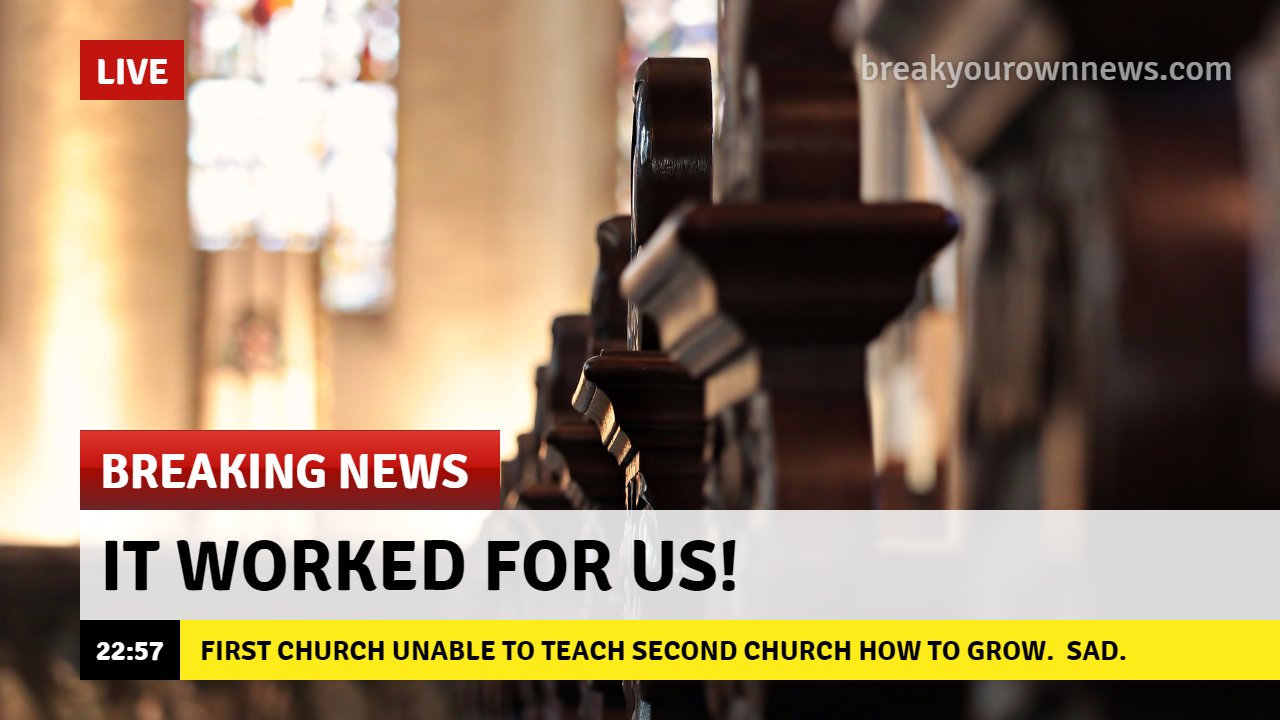
“It Worked for Us” is Insulting
 
I started in full-time ministry 23 years ago.  At the time, I was unaware of the decline in the Christian church.  When I went to college in 1987, Willow Creek had established itself as a pioneer in new church, non-denominational growth.  Things were looking up.  People flocked to Willow Creek both for worship and for leadership training. 
 
It wasn’t long after I began serving in full-time ministry that church officials, pastors, and even lay persons were becoming anxious about declining membership numbers. The factors that contributed to the initial decline in membership created a new level of anxiety for congregational leaders.  But as time went on, that anxiety began to fuel future decline.  The more we worried about decline, the worse it got.  In other words, worry about decline became a self-fulfilled prophecy.
 
The “quick fix” mentality swung into full gear by the late 90’s.  Large congregations, those worshipping above 200, who were experiencing significant success in membership growth, started to charge smaller congregations (many who were being pressured by judicatory leaders to address the decline) a fee to come and learn “what worked” for them.  The teaching was done with good intentions.  The result?  None of it was transferable.  The learnings from the larger congregations did not translate well to the smaller congregations.  There may have been a few exceptions to this, but on the whole, nothing changed.  Despite all of the teaching on best practices, the mainline church continued to decline and has yet to level off.  We are closer than ever to the brink of extinction, and yet we continue to push the same paradigm, hoping things will change.    
 
 
Clickbait for Congregations
 
Most leadership institutions for clergy are intellectually lazy.  Desperate to hold your attention and provide something of substance, they look for any congregation anywhere that has any kind of success which is then offered up as a possible new model.  I recently read one such article that pointed to church growth for a couple of congregations that moved their main worship from Sunday morning to Wednesday evening.  As if that’s the key.  While I don’t dispute the examples that were given, correlation does not equal causation. 
 
I don’t doubt that these organizations are publishing these ideas with the best of intentions.  They may even offer them with the hope that it will inspire creativity, thinking outside of the box, and perhaps throw open the flood gates of new ideas.  Is it any wonder that we are in decline as pastors continue to implement any idea that looks remotely promising?  And then we wonder why it is so difficult to find volunteers.  This process is exhausting!
 
If I’m going to move my worship services from Sunday to Wednesday, I want to know some specifics.  I want to know success rates.  I want to know about as many variables as possible.  I want to know something about the churches that had success.  Tell me about the functional level of the person leading the effort to change.  Tell me about the functional level of the congregation and its leaders.  Tell me about their track record in making these types of changes.  Tell me about the process they used to make the change.  Tell me about the resources that were available to them.  Tell me how they handled the predictable pushback.  Tell me about the effects of the change on the growth of the congregation one year out and five years out.  Was it worth it and how did they measure it?
 
Church growth coaches and educators simply offer a glowing review of a congregation’s success without any relevant, factual data about the total effort that went into making the change.  No one seems to be capturing the entirety of the markers of the process that led to success.
 
I call this effort (to only publish the results and not the process) “clickbait” because church growth organizations are giving into the temptation to use catchy headlines and engaging subtitles to attract desperate pastors and congregational leaders who will try anything once to calm their anxiety.
 
 
The Answer is Thinking!
 
Don’t be conformed to the patterns of this world, but be transformed by the renewing of your minds so that you can figure out what God’s will is—what is good and pleasing and mature.  Romans 12:2 (CEB).  What’s important to me is not the results of the effort, but the process that went into the effort.  What do successful leaders think about at each milestone of congregational growth?  What’s on their mind? How are their minds being transformed?  How are the minds of the congregation being transformed?  Did they ever catch a break that helped them make it to the next level?
 
I’ve never interviewed a successful pastor, something I would love to do, but this is what I would guess they think about:

  1. What is the context of my congregation?  Where is it located?  Who is attending?  Who is not attending?  What is the nature of the community I’m serving? What is the congregation’s historical connection with the community?  How connected is the congregation to the community?
  2. What is the functional level of the congregation?  How well do they do when challenged?  How well do the leaders function?  How tense are the relationships in the congregation?  How do they process anxiety?  Who needs to stay in leadership, and who needs to rotate out?
  3. How am I reacting to the congregation?  Am I stressed and anxious about the congregation or am I confident about the future?  To what extent am I able to step back and think about the challenges the congregation is facing?  What will it take for me to be a better leader?  What will it take for me to be emotionally neutral (not take sides or blame others or self) in my relationship with each person in this congregation?  What am I willing to tolerate?  What am I not willing to tolerate?  What is this congregation capable of achieving?  What am I capable of achieving?
  4. Who are the people in the congregation who are motivated to be the best version of themselves?  Who is as invested in their life as they are in the life of the congregation?  Who are the most mature, responsible individuals in the congregation?  What will it take to get them engaged?  What is the best way to challenge them?
  5. What is the identity of this congregation?  What is the congregation hoping to accomplish down the road?
  6. What are the steps that will lead to implementing the vision?  What will it require of the congregation?  What resources are available to do this work and what resources are needed?  Who has the capacity to make this happen?
 
As you can tell, it’s not sexy.  It’s not something that can fit into a headline nor catch your attention in five to seven words. It’s not a quick fix, and it’s certainly not something you can learn in an all-day training, over a weakened, or even at a week-long event.  It takes a consistent, persistent effort over time.  There are no shortcuts. 
 
To be clear, there is a time and a place for resourcing and training congregational leaders.  I do it, others do it, and it’s important.  But the focus of training needs to shift radically from programs and ideas to thinking and process.  Once the thinking and process are engaged with lower levels of anxiety, programs and ideas will follow.
 
Who is training congregational leaders to do this work?  What seminaries teach these types of skills?  What “teaching congregations” are offering these types of classes?  What institutes are promoting differentiation of self?  The answers? Very few.  Why?  Because, on the whole, denominational leaders have yet to admit that the current paradigm for training no longer works.  The organizations that resource local congregations are so reactive to our current plight, they seem to lack the capacity to redirect their efforts and pull up. 
 
It’s possible that even the best leaders we have are not aware how they perpetuate the challenges we face.  They may be so focused on the content of solutions that they too are missing how a focus on thinking and process can solve these challenges.  Congregations succeed not because of the programs, content, or techniques of a specific model.  They succeed because of the resiliency of the relationship system in the church and the process that goes into creating a vibrant congregation.  It is fundamentally about the relationship system whether we’re talking about the congregation, the family, the neighborhood, the community, or society in general.  The sooner we embrace this reality and train congregational leaders to engage their thinking in the context of the relationship system, the better chance we have of transforming ourselves and local congregations.
2 Comments

    Author

    John Bell is the thinker behind Thinking Congregations.  As a thought partner he believes the best way forward is for leaders to do their best thinking.

    Subscribe!
    Click here to receive the blog by email. 

    Archives

    February 2020
    April 2019
    March 2019
    February 2019
    January 2019
    December 2018
    November 2018
    October 2018
    September 2018
    August 2018
    July 2018
    June 2018
    May 2018
    April 2018
    March 2018
    February 2018
    January 2018
    December 2017
    November 2017
    October 2017
    September 2017
    August 2017
    July 2017
    June 2017
    May 2017
    April 2017
    March 2017
    February 2017
    January 2017
    December 2016
    November 2016
    October 2016
    September 2016
    August 2016
    July 2016

    Categories

    All
    Beliefs
    Change
    Chronic Anxiety
    Community
    Conflict
    Death
    Differentiation
    Emotional System
    Fear
    Individuality
    Leader
    Meeting
    Motivation
    Multigenerational Transmission Process
    Observing
    Over Functioning
    Process
    Projection
    Regression
    Togetherness
    Training
    Transition
    Triangle
    Under Functioning
    United Methodist
    Vision

    RSS Feed

Services

Blog
Coaching
Events


Company

About
Contact
© COPYRIGHT 2015. ALL RIGHTS RESERVED.