
Thinking Congregations
  • Home
  • Blog
  • Coaching
  • Events
  • About
  • Contact
  • Home
  • Blog
  • Coaching
  • Events
  • About
  • Contact

Finding Clarity

11/27/2016

2 Comments

 
Picture

Seeing anxiety at work.
 
The challenge for many of us is being able to see anxiety operating in relationships.  There is a back and forth that goes on as anxiety is passed from one to another.  It’s as if there are channels between us through which anxiety travels.  I have an energy ball I use from time to time to teach kids about the important connections of community.  The ball is small and has two metal tabs on the top with a very small battery on the inside.  I ask the kids to hold hands in a circle, completing a circuit.  I then ask the last two kids on either side of the ball to touch the tabs with a finger.  With the circuit complete, the ball lights up and makes a sound.  I once had a whole congregation, about 200 people, do this exercise and it worked!
 
I’ve come to see this experiment as an example of anxiety.  There is an anxious “charge” (however unnoticeable) that flows from person to person.  Like the energy ball, anxiety flows from things like tone of voice, the expressions on the face, gestures with the body, and posture.  As each person senses the anxiety in others there are automatic ways they either absorb the anxiety or pass it along.  As in the example of the energy ball, anxiety can be passed along from one person to the next, but it takes a system of relationships to complete the circuit.
 
It takes time to be able to see the flow of anxiety in a relationship system.  Like the energy ball, the flow of anxiety can seem invisible.  What’s required is the ability to step out of the emotional field of anxiety.
 
 
Getting out of town.
 
I recently drove out of town for an all-day event.  On the way home, I noticed something different.  For several days my thinking had been cloudy; what I would describe as reactive to others.  I just wasn’t at my best.  At some level, I was aware that my struggle had to do with other people.  I had been under some stress at work, and there were some changes taking place in the family.    
 
As I drove home, I experienced clarity of thought.  I suddenly found creative solutions to problems I had been struggling with for days.  My thinking was freer.  It lasted most of the drive home. 
 
But then, as I drove into town, I watched my thinking become fuzzy again.  I was able to recall the solutions I had come up with just hours before, but now I had less confident about them.  Dr. Murray Bowen describes a similar process as he recounted his time at Menninger Clinic in Topeka, Kansas.
 
“I noticed that when I was away on trips I was much clearer and more objective about work relationships, and that the objectivity was lost on returning to work.  After it was first noticed, I made more careful observations of the phenomenon.  The objective could come by the time the plan was an hour away.  On return, the objectivity would be lost as I went through the front door returning to work.  It was as if the emotional system “closed in” as I entered the building.”  Family Therapy in Clinical Practice, page 485.
 
There is something to be said about getting out of town.  Not in the sense of needing a vacation, but to be able to think more clearly outside the emotional constraints of a relationship system, whether it’s a congregation or a family. 
 
 
Mindfulness and Differentiation
 
The Center for Family Consultation hosted a conference on mindfulness.  The purpose was to explore the relationship between current day research on mindfulness and the theoretical concept and application of differentiation of self posited by Dr. Bowen.  Mindfulness and differentiation of self are not the same things.  While it’s possible for those who work on differentiation of self to experience something like mindfulness, those who practice mindfulness are not necessarily working on differentiation of self. 
 
Mindfulness is an effort to create a state of awareness.  As one begins to work on differentiation, there is an initial effort to become more aware of one’s internal responses to others and how others respond to you.  Differentiation is acting on new levels of awareness as one moves towards individuality to counterbalance the forces for togetherness.  Mindfulness does not automatically lead to differentiation. 
 
When used as an effort for differentiation, mindfulness is one way temporarily to step out of the tension in a relationship system.  If one can’t get out of town, meditating and developing a sense of awareness are alternatives.  Finding space at work or at home to practice a mindfulness technique can help one step outside of the emotional process long enough to activate thinking in the brain. 
 
But just as Bowen noted in his example of leaving town and coming back, the real work of differentiation is being able to sustain a thinking oriented mindset while engaging the relationship system.  How long can one maintain thinking while surrounded by anxious others?  What does it take to engage thinking when one is anxious?  Mindfulness meditation, getting out of town, neurofeedback, and other efforts can increase awareness.  But it is the effort to be more of a self, a thinking self, in the presence of anxious others that distinguishes differentiation from other approaches.
 
I’ve discovered that I’m at my best when my thinking is engaging the thinking of others.  It may require me to set aside intentional time to think about how to approach a relationship system that stirs my anxiety and reactivity.  But it is not until I engage the relationship system in a different way that I begin to make lasting shifts from being reactive to becoming more thoughtful.
 
 
How to tell the difference between reactivity and thinking.
 
The best advice I give is to think systems.  I’ve been at this work for over 13 years, and I still get caught up in reactivity, struggling to be a good thinker.  I find it useful to distinguishing between those times when I’m thinking and when I’m reacting to anxiety.  How does one tell the difference and what leads to clear thinking as one gets outside of the relationship system?  The answer varies from person to person.  One knows it when they think it.  A good coach can show the way.
2 Comments

Thanksgiving, Homo Sapiens, and United Methodist

11/21/2016

0 Comments

 
Picture

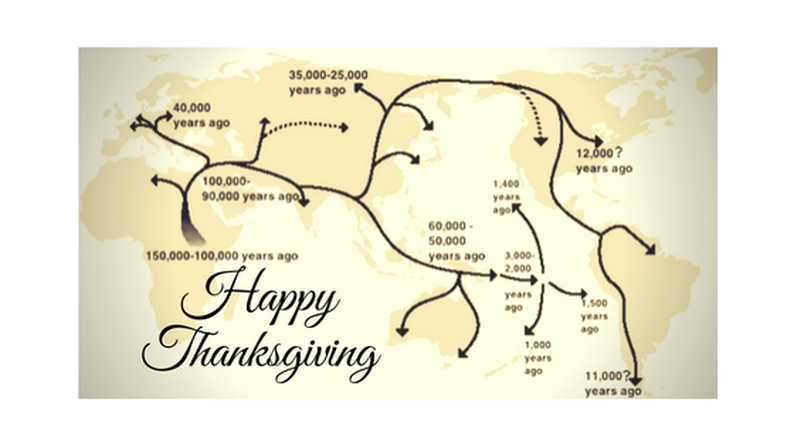
Thanksgiving will be celebrated by millions of people in the United States this week.  We were taught that the holiday is a commemoration of the first meal between Europeans and Native Americans.  More recently, some have reshaped the narrative towards a story of immigrants and refugees.  What new ways of thinking might emerge if we place our current reality within a context of historical patterns of migration?
 
Since the time our ancient ancestors left Africa, humans have always been migrating.  Archaic humans, like Homo Erectus and Neanderthals, made slow progress over millions of years out of Africa, ending up in places like Western Europe and Southeast Asia.  Something significant changed 100,000 years ago during the late Pleistocene period.  Humans began to disperse across the globe with unprecedented fervor, making the Mayflower look like an afternoon of sailing on the lake.
 
 
Leaving Africa
 
I presented a paper last year constructing a case that the mass migration that took humans to every corner of the world was driven by reactivity to conflict.  Archeological evidence reveals how it may have happened.  As tribes headed out of Africa, problems between tribal members would inevitably erupt into conflict.  Not unlike today, the complexities of the conflicts would include things like allegiances, spoken and unspoken rules, hierarchical structures, and kin relationships.  If the relationship system became too intense, tribes would face a dilemma.  They could blame one person or group resulting in ritualized punishment.  Or, they could ostracize one group by forcing them out (or letting them flee).  Those who left would have to learn to fend for themselves wherever they ended up.  The archeological evidence suggests that some groups settled in hostile terrain making the idea plausible that it was easier to learn to survive in adverse environments than risk inhospitable conditions back home.  (You can read Penny Spikins article on this subject)
 
Fast forward 99,500 years.  Is it possible that a similar phenomenon played out in the journey of Europeans to the North America continent 500 years ago?  Hundreds of thousands of people would leave Europe to live in rugged terrains and endure harsh winters.  Was it to flee tribal conflict at home?   The conflicts are often categorized as religious.  Faith may have been the context.  But how do you explain the process?  If you want to read more about my thinking on how religious beliefs do not adequately explain family tension, read my blog post “Interfaith and the Family.”
 
Many of the early refugees from Europe did not survive, and in some cases, entire communities perished.  It’s as if the desire to escape the tensions at home disrupts one’s ability to assess risk accurately.  I don’t want to rule out the possibility that some people left Europe in the pursuit of adventure.  But based on my observation of human behavior, it seems much more likely they were fleeing tension in the relationship system.
 
 
The Concept of Cutoff
 
In order to understand the complexities of our current social situation, having a historical view of migration is useful.  A helpful theoretical idea comes from Dr. Murray Bowen who proposed the concept of cutoff.  A good review of the concept is available here. 

When the relationship between a parent and child becomes too intense (what Bowen described as fusion), adult children may distance and run away from the family with little to no contact for years to come.  Parents play their part in the distancing effort, too.  There are short term benefits to distancing.  It reduces tension in the relationship system.  However, the long-term consequences include an increase in the level of intensity in the new family configuration which makes it more than likely that the next generation will also move towards distance and eventually cut-off.  And thus, a pattern is born. 
 
 
Leaving Europe
 
What if some Europeans saw North America as a way to manage the intensity of the relationship system at home by hoping for a fresh start?  As they started new families in a new world, would the patterns they sought to avoid in the old world repeat themselves in the new?  Would the family in the new world exhibit more or less intensity?  Bowen Theory suggests that the problems in the relationship system would get worse in the subsequent generations, not better. 
 
 
Leaving The Church of England
 
Included among the Europeans who fled to Norther America were Methodist coming from England. John Wesley and his brother Charles launched a movement to reform the Church of England in the 18th Century.  While this movement would eventually create a new denomination, John Wesley’s earliest efforts were to transform the Anglican Church.  However, Methodist who settled in North America banded together on Christmas Eve in Baltimore, Maryland, in 1784 to form what would become the Methodist Church.
 
Many of the early pastors of this movement were assigned circuits (some with 12 churches).  They rode horseback, spending only a week at a time with each congregation.  This experience of congregational leaders having limited contact, coupled with the cutoff many experienced from their families in England, became the foundation for the development of this new Methodist movement in North America.
 
 
United Methodist and Cutoff
 
It has long been understood that pastors who are leaving a congregation must, as a professional courtesy, cutoff their professional contacts with the congregation by refusing to perform weddings, baptisms or funerals unless given permission by the incoming pastor.  Such policies were created to curtail the interference of the previous pastor.  Continued contact with the congregation after the appointment is over is thought to limit the ability of the incoming pastor to been “seen” as the pastor. 
 
This rule makes sense in a historical context – individuals running away from families in Europe and elsewhere, circuit riders having limited interaction with congregations, and a world migration pattern of cutoff.  When faced with challenges in the relationship system, we lean towards cutoff.  I know some will be quick to give examples of how former pastors have interfered with the work of the incoming pastor.  I don’t think these instances are numerous and I don’t believe policies that encourage cutoff are the answer.  There are other ways to handle these situations that can lead to better outcomes for everyone.
 
Dr. Bowen’s ideas about emotional cutoff are relevant to the coming and going of clergy from one congregation to the next.  Whether the same emotional process found in a family is active in larger relationship system like a congregation is debatable.  Specifically, the degree to which the emotional process influences behavior.  Bishops and District Superintendents see variation in the functional level of clergy as they enter and leave a congregation.  Some clergy are better than others in managing their anxiety during these times of transitions.  Some have a smooth entry while others seem unable to make vital connections which are essential for a long-term partnership with laity in ministry.  Some clergy can countdown their departure and lift off effortlessly when the appointment ends.  Others struggle to find the door, continuing to provide pastoral care to a “select” group in the church to which they feel a particular kinship.
 
The extent to which congregational leaders manage their anxiety that accompanies welcomes and goodbyes is connected to the level of cutoff in their family of origin.  I have yet to read any research connecting these two ideas, and yet the relationship between the two makes sense.  If one is cutoff from the family (namely parents – one or both), it means more of the anxiety is focused on the current relationship system, which includes clergy and other congregational leaders.  This level of focus makes leaving more challenging and welcoming more intense.  For some, particularly clergy, leaving may not appear to be a problem at all and their ministry could be defined as one of superficiality or distant interactions with the congregation.
 
For those who have difficulty connecting with a congregation or who find leaving difficult, it’s worth exploring the pattern of cutoff in one’s family.  One way to do this is to make a list of all the people in the family.  Who do you know?  Who don’t you know?
 
 
Thanksgiving and Cutoff
 
I originally wrote this blog about a month ago.  As I was preparing to post it, I realized it could also be relevant to those who are celebrating Thanksgiving this week.  The original intent of this blog was to shed light on how the current practice for United Methodist clergy leaving and entering a congregation could be seen from a historical perspective.  But the reactivity from the election is also relevant and could even be worthy of a separate blog post.
 
As families struggle with how to be together this Thanksgiving, it’s worth considering that they are in good company.  Not just from a national perspective, but from a historical one.  The pattern of cutoff has been passed from one generation to the next for thousands of years.  How does one interrupt their automatic tendency to cutoff with family members?  How can one be present with the family and manager their own reactivity?  Is the struggle to be present with certain family members something new or is it being accentuated by post-election rhetoric?  How is this election an opportunity to work on self-regulation and what Bowen called differentiation of self?  It is easy to blame the other and to distance from them than to step back, reflect, work on awareness, take responsibility for one’s part in the problem, and change the way one interacts with the family without controlling others or avoid them. 
 
 
Bridging Cutoff in the Family
 
The following are examples of what differentiation of self looks like and doesn’t look like when working on cutoff:
 
It is working on developing a one to one relationship with each person in the family.
It is not contacting people to learn what’s happening with other people in the family.
 
It is initially about short contacts with a clear purpose.
It is not staying overnight or for long weekends.  This may come later, over time.
 
It is working at understanding what is; looking at facts.
It is not letting false assumptions or perceptions go unchallenged.
 
It is about regulating one’s own reaction.
It is not telling other people what to do or staying away.
 
It is being clear about why each relationship is important and focusing on that importance.
It is not about leaving it up to the other to decide what is important for you. 
 
It’s about making contact.
It is not about leaving it up to the other to make contact.
 
It is about engaging the thinking of the other.
It is not about sharing feelings with each other.
 
It is an opportunity to increase one’s functioning.
It is not cathartic.
 
 
Each person gets to decide what direction they want their life to go.  Especially when it comes to having a relationship with the family.  If one desires to have a more open relationship with the family, the question then becomes, at what point does one find the courage to begin this effort?  If not now, when?  The only way to develop more open relationships in the family system is to slowly begin the work of engaging each member through the process Bowen described as differentiation of self.
0 Comments

Are We Regressing?

11/13/2016

3 Comments

 
Picture

For many people, this election feels like a regression; a step back in the behavior of the society and individuals.  Does making America great again mean going back to a time of unchecked racism, sexism, xenophobia, misogamy, large scale wars and lack of concern for the environment?
 
Regression is defined as a return to a former or less developed state.  Those who voted for Clinton or a third-party candidate fear we are headed back to a time when we were not at our best as a nation. 
 
Dr. Murray Bowen worked on a paper from 1972-1973 entitled Societal Regression as Viewed Through Family Systems Theory.  He was invited to present a formal paper on a new governmental agency, the Environmental Protection Agency.  While Bowen’s paper dealt with environmental issues, the ideas contained in the paper accurately predict the trends we see today.  He writes:
 
Man is not willing to give up the easy life as long as there is a way to “have his cake and eat it too.”  If my hypothesis about societal anxiety is reasonably accurate, the crises of society will recur and recur, with increasing intensity for decades to come.  Man created the environmental crisis by being the kind of a creature he is.  The environment is part of man, change will require a change in basic nature of man, and man’s track record for that kind of change has not been good.  Man is a versatile animal and perhaps he will be able to change faster when confronted with the alternatives.  I believe man is moving into crises of unparalleled proportions, that the crises will be different than those he has faced before, that they will come with increasing frequency for several decades, that he will go as far as he can in dealing symptomatically with each crisis, and that a final major crisis will come as soon as the middle of the next century.  The type of man who survives that will be one who can live in better harmony with nature.  This prediction is based on knowledge about the nature of man as an instinctual being, and on stretching existing thinking as far as it can go.  There are many questions about what man can do about his environmental crisis.  The thesis here is that he might modify his future course if he can gain some control over his reaction to anxiety and his “instinctual” emotional reactiveness, and begin taking constructive action based on his fund of knowledge and on logical thinking.  (Family Therapy in Clinical Practice, page 281)
 
How do we make sense of the election results?  One possible answer lies in understanding the emotional system.  The emotional system motivates us through automatic, reactive behaviors that keep us alive.  The emotional system is essential to the survival of all life.  It is not feelings, although you can experience the emotional system through feelings.  There is a fantastic video by Dr. Antonio Damasio who describes the emotional system.  Be advised that he is talking about science, not theology.  You can watch the video by clicking here.
 
In addition to the emotional system and the feeling system, we are blessed with an intellectual system in the prefrontal cortex.  The intellectual system allows for the possibility of self-regulated behaviors. 
 
Everyone knows that when we are confronted with a threat, our basic response patterns are fear based in the form of fight, flight or freeze.  Societal influences can accentuate our perceived level of fear.  Rising tides, increasing numbers of hurricanes, the threat of a superbug, the exposed fragility of food distribution, and the increasing density of populations all contribute to a perception of shrinking resources for an ever expanding population.  While we may not think about it consciously, we are deeply aware that our planet is becoming less and less sustainable.  And it makes us anxious.
 
At the level of the individual, that are two fundamental problems.  How do we accurately assess a threat?  And how do we interrupt our automatic responses to a threat?  We are highly sensitive to the reactivity of others.  In some ways, we are wired to react to the perception of threat from others.  If someone else perceives a threat and reacts strongly to it, there is a more than likely chance others who witness their reaction will also have a stronger reaction, even if they have not personally experienced the threat.  So, the behavior of others can influence our behavior.  Whether it’s a congregation, a family, or even the broader society, when tension in the relationship system goes up, automatic responses increase. 
 
What’s fascinating is the amount of variation found across the spectrum of human beings.  All of us vary in how quickly and how intensely we respond. Some people require a high level of tension to slip into an automatic response.  Some people respond automatically at more moderate levels while others react to only a slight increase in perceived threat.
 
Throughout history, and not just religious history, you can see the ongoing struggle of people to address this process.  As tensions have increased, societies have at times blamed others in response to a threat.  At other times, societies have risen above the anxiety of the moment to find solutions to the problems they faced. 
 
In my faith tradition, Jesus talked about being kind to those who are ungrateful and wicked.  Jesus never said, “You’ve heard it before fight, flight, or freeze, but I say to you think!”  Essentially, though, this is what he was after in many of his teachings.  How do you override automatic tendencies?  There was the story of dozens of men standing around a woman with rocks in their hands, ready to killer her for allegedly committing adultery.  Jesus engaged the thinking of the crowd.  They dropped their rocks and walked away.  We have the gift of the thinking brain, the prefrontal cortex that helps us see our options for dealing with a perceived threat.  We do not have to be governed by automatic responses.  We can make choices.
 
Most faith traditions teach the importance of self-awareness – an awareness that engages a more thoughtful approach to the world.  We teach about forgiveness, not blaming others, second chances, etc.  The challenge is to interrupt automatic responses (fight, flight or freeze) when we interact with others and to be more intentional.  Whether we use religious terms like integrity or scientific language like cognitive integration, the efforts are similar.  It’s the struggle to see “what is” and not what one imagines, desires, or perceives as reality.  How do humans see the world as it is?
 
Like a microscope, Bowen’s ideas help us peer into complex societal problems to see a basic structure residing in the family.  If one looks all the way to the level of the individual, it’s not possible to see the emotional system.  The relationship system is needed in order understand emotions.  At the level of the family, we can see how parents relate to each other, to their children, and to the extended family.  There are patterns that emerge and these patterns become predictable.  As one begins to understand the predictable nature of the patterns in the family, it is possible to move from a reactive, automatic state to a more thoughtful, self-regulated state. 
 
Our ability to do this work is influenced by the level of chronic anxiety in the system.  When the family is overtaxed, beyond its capacity to respond to the problem, family members will turn to extended family members and friends.  If there is a limited number of relationships outside of the family, individuals may turn to institutions to decrease their anxiety.  Schools, social agencies, government entities, and churches are filled with the overflow of the emotional process from anxious families.  As these institutions and organizations attempt to address the presenting family problem, the relationships systems found in institutions becomes more anxious.  The level of chronic anxiety has to do with the ability of the members and leaders of the organization to address problems effectively and self-regulate their reactivity. Another way to say this: to the extent leaders are able to engage their thinking about a problem it will override the automatic, reactive responses.  Some people experience it as calm.  Others experience it as problem solving which includes better functioning of the family, institution, and society. 
 
Bowen’s ideas on differentiation of self is relevant for today.  For those who struggle to make sense of and respond to our current reality, theory provides a useful way of making sense of what’s happening. 
 
More than this, it provides a way forward (for those who are motivated) to reverse the trend of regression.  It begins with the self; learning to self-regulate in the presence of anxious others.  From there, the mindset of differentiation of self can guide one’s interactions with others; respecting the other as a separate person while coordinate activities with them and being clear about what one is able to do and not able to do.  From there, leaders in organizations who continue to work on differentiation engage clients and other institutions in a different way; partnering together to do their best thinking about a problem and not giving into short-term, quick-fix reactivity.
 
However, let’s be clear: the emotional system is powerful.  It is difficult to see it in action and even more challenging to override automatic behavior. Most of what we are experiencing through the media and social platforms is automatic reactivity driven by the emotional process. 
 
I don’t know if the worst is yet to come.  I do know we can stay the destruction of our democracy.  The path forward is for motivated individuals to keep thinking systems while at the same time putting one foot in front of the other working day by day, encounter by encounter to increase their basic level of differentiation of self.  There is nothing new about this.  It does not depend on other people to join in the effort.  One person can make a big difference in their family, institutions or any relationship system.
 
Solutions can be found in the ability of each person to become aware of the ways the emotional process works in one’s family of origin and then to function as a more responsible, mature person in the family.  Of course, it’s much easier to blame others and demand more from them instead of looking at one’s own functioning in a family context. 
 
I’m committed to this process because I believe it is important and because I am convinced it works.
3 Comments

Interfaith And The Family

11/6/2016

0 Comments

 
Picture

Show me two families with completely different religious beliefs, and I’ll show you two families with common family problems. 
 
When I talk to people from different faith traditions, while we may not agree on the nature of God, we can agree on the rebellious nature of teenagers, the competitive nature of siblings, and the challenge of gathering the family for the holidays; whatever holiday it may be.  Underneath the wave of differences between many faiths is an ocean of mutual family dynamics. 
 
I recently met a young woman who is Hindi.  When she discovered I was a pastor, she struck up a conversation about religion.  She considers herself spiritual but not practicing.  The religion of her parents is not helping her address the complexities of the world.  After college, she married a Christian.  Early in their marriage she occasionally attended services at her husband’s church.  However, she made it clear to me that she is not interested in becoming Christian.  She quoted Gandhi: “I love your Christ but I hate your Christians because your Christians are unlike your Christ.”
 
With my interest in family systems, I asked how her decision not to practice the religion of her parents was playing out with them.  She reported to me that her parents accepted her position over time.  She continued sharing that like many children growing up in religious homes, she had little to no choice in attending temple.  For most families, there’s one child who religiously rebels.  The tug-of-war between parents and children over participating in religious traditions is more about the family emotional process then about someone’s religious beliefs.
 
During a Confirmation Service (in mainline Protestant churches, it’s the ceremony to mark when children become official members of the church), I stated that the students no longer needed their parents to remind them to get out of bed for services or pressure them to attend.  They were now responsible members of the congregation.  For one specific confirmand, this was all he needed to hear to stop.  He stopped attending church.  Several months later, with sarcasm in her voice, his mother said to me, “Thanks a lot.  I can’t get him to come to church anymore.  He keeps reminding me what you said about how he is old enough to make his own decisions.”
 
Conversations like these make me wonder if the decline in the Christian church has more to do with an emotional process between parent and child and less to do with religious practices.  For parents, they can spend most of the child’s life pulling them along to services.  The more they pull, and the older the child gets, the more firmly the child’s feet get planted.
 
It’s probably best to leave my thoughts on this for another blog topic.  Suffice it to say, one of the problems in educating children today about faith is the tendencies to teach only content.  Children are better prepared for adulthood if we teach them how to ask their questions, how to sit with their questions, and how to think.  When working with adults who are going through a spiritual crisis, these are often the developmental skills they lack.    
 
 
Congregational struggles are identical across faiths.
 
I recently read a list of training opportunities provided for local Imams.  The breakout modules were:
 
Increasing the Effectiveness of Masjid Boards
Creating the Inclusive, Welcoming, Dynamic Masjid
Recruiting Volunteers
Turning Your Masjid into a Green Masjid
Strategic Planning: The Why’s and How’s
 
How interesting that these issues are similar to one’s I deal with!  In fact, one could easily replace masjid with church or synagogue a still be relevant.  We are all dealing with similar congregational issues.  How do you get boards unstuck and more effective?  (Well, actually you can read a recent blog post to answer this question).  How do you focus on the mission of the congregation and not be bogged down with less important issues?  This emotional process is at work, running underneath all faiths, families, and all congregations.
 
 
The Myth of Shiksa
 
I first came across this idea, that behavior is more about emotional process than it is about cultural practices, when I read Rabbi Ed Friedman’s book The Myth of Shiksa and Other Essays.  Friedman makes the case that the Jewish concept of Shiksa, where a gentile woman woos the Jewish son away from his family and religion, is not unique to Judaism.  Every culture has some version of this family dynamic. 
 
This past year I watched the documentary Met the Patels which follows one man’s struggle between the woman that he loves and his parent’s desire for a wife from their culture.  What families often claim as uniquely cultural or religious is common to all families.  What is the commonality?  It is reactivity.  It’s as if parents who are less flexible and adaptable to change become more likely to demand compliance from their children and predicate the compliance on cultural and religious claims.  However, more flexible parents like the Patels are more than likely to adjust and effectively address the different thoughts, feelings, and actions of children.  We often view a stubborn parenting position as a struggle for defending cultural.  We tend to view more flexible parenting as less concerned about preserving culture.  It is possible for a parent to strongly identify with a culture and faith tradition while at the same time watch their children follow their own religious (or non-religious) life pursuits. 
 
 
The Common Struggle
 
It may sound ridiculous for me to say it, but the problem with world religions is that parents often elevated compliance over thinking.  The problem is not in the realm of heresy; it is within the framework of reactivity which is stimulated when children and parents hold opposing religious views.  The level of reactivity and how parents respond to their children’s opposing views depends on what Dr. Murray Bowen called the level of differentiation.
 
When levels of differentiation in the family are low, reactivity that demands blanketed agreement of a specific set of belief will come at a cost.  On the macro level, it is a motivating factor for genocide. On the micro level, it is a contributing factor in the onset of psychological, physiological, and behavioral problems in childhood and adolescence. 
 
 
Finding The Way
 
Our world is better served by congregational leaders who don’t just teach the content of their sacred texts but also teach a hermeneutic of discovery that encourages individuals to do their best thinking about their faith.  This approach does not rely or depend on the thinking of others.  The approach does include creating class time were individuals present their best thinking about a faith topic.  It requires congregational leaders to be intentional about disrupting the emotional process from getting in the way.  It invites individuals to speak to the congregation about their efforts to integrate beliefs into action, parenting classes addressing how to handle different religious perspectives in the family, coaching that assists individuals in understanding the relationship between beliefs and the family emotional process, and encouraging people to be courageous in their efforts to be clear about their beliefs, core operating principles, and life goals.  Faith communities that survive and thrive over the next 100 years will promote some version of this effort.  Congregations (relationship systems comprised of families) that insist on members feeling, thinking and acting the same way will be left to the historians.  Those who work on differentiation of self will lead faith communities into the future.


0 Comments

    Author

    John Bell is the thinker behind Thinking Congregations.  As a thought partner he believes the best way forward is for leaders to do their best thinking.

    Subscribe!
    Click here to receive the blog by email. 

    Archives

    February 2020
    April 2019
    March 2019
    February 2019
    January 2019
    December 2018
    November 2018
    October 2018
    September 2018
    August 2018
    July 2018
    June 2018
    May 2018
    April 2018
    March 2018
    February 2018
    January 2018
    December 2017
    November 2017
    October 2017
    September 2017
    August 2017
    July 2017
    June 2017
    May 2017
    April 2017
    March 2017
    February 2017
    January 2017
    December 2016
    November 2016
    October 2016
    September 2016
    August 2016
    July 2016

    Categories

    All
    Beliefs
    Change
    Chronic Anxiety
    Community
    Conflict
    Death
    Differentiation
    Emotional System
    Fear
    Individuality
    Leader
    Meeting
    Motivation
    Multigenerational Transmission Process
    Observing
    Over Functioning
    Process
    Projection
    Regression
    Togetherness
    Training
    Transition
    Triangle
    Under Functioning
    United Methodist
    Vision

    RSS Feed

Services

Blog
Coaching
Events


Company

About
Contact
© COPYRIGHT 2015. ALL RIGHTS RESERVED.