
Thinking Congregations
  • Home
  • Blog
  • Coaching
  • Events
  • About
  • Contact
  • Home
  • Blog
  • Coaching
  • Events
  • About
  • Contact

Mixing Theory and Theology

1/27/2019

1 Comment

 
Picture

On the surface, Bowen theory and theology are like oil and water.  They don’t mix.  Dr. Murray Bowen, a research psychiatrist, spent his life developing, teaching and applying his theory of human behavior.  Institutions of faith spend their time preserving systems of beliefs and practices.  At times, however, Bowen theory is miscible with theology like steamed milk and espresso.  I will attempt to connect the observations of reactivity found in Bowen theory with the concept of crucifixion and resurrection found in Christian theology.
 
I was invited by a colleague to be one of seven guest preachers at a Good Friday service.  There is a tradition in some congregations to reflect on the seven last words (really sentences) of Jesus.  I was assigned the words: “Father, forgive them.  They don’t know what they are doing.”  It’s a remarkable phrase if you think about the context.   
 
Jesus, at the time of his arrest, trial and crucifixion, was abandoned by those who knew him, loved him and followed him.  They ran away, denied knowing him and orchestrated his arrest.  The image of Jesus on the cross is a picture of betrayal.  It is from there that Jesus utters the words, “forgive them.”  And then he comes back from the dead to forgive them.
 
In my sermon at that Good Friday service, I predicted how I would respond If I were left for dead.  If it were me, and I could come back from the dead after being abandoned by my family and close friends . . . there would clearly be hell to pay!  Forget about love and forgiveness.  Instead, there would be retribution and retaliation; manifestations of my reactivity.  At the very least, it would be a struggle to come back and forgive. 
 
In Bowen theory, reactivity to anxiety (a response to a perceived fear) is woven throughout Bowen’s eight concepts.  As anxiety increases so too do our automatic responses to it.  In the family, people are continuously adjusting their physical and emotional spaces to one another in response to anxiety.  As anxiety increases, people either move towards others or they create distance.  These shifts towards and away from others are automatic.  However, people do have the capacity (although there is wide variation from family to family) to disrupt this automatic response by being more objective and thoughtful. 
 
Dr. Murray Bowen observed that through a differentiated intellectual system, one could use beliefs and core principles to not react automatically to a rise in anxiety.  He proposed that there is a way for individuals to manage themselves better when anxiety goes up in the family.  It includes engaging one’s best thinking.  In three of the four gospels it states that, when Jesus appeared in the resurrection to those who had abandoned him, he did not react or retaliate.  Instead, he forgave them and offered them peace. 
 
More than just a moral influence, Jesus behaves differently (does not react) and in so doing ends, in his body, a cycle of violence and hatred (automatic reactivity).  By not retaliating, Jesus creates opportunities for others to shift their functioning to be less reactive and more belief driven.
 
Dr. Bowen observed the behavioral outcomes of rising levels of anxiety in families with limited capacity for self-regulation.  The family functions as an emotional unit with each person playing a part in managing the family anxiety.  For example, as anxiety rises, an individual in the family is singled out as the source or cause of the anxiety.  In response to the anxiety, families may blame, distance or cutoff from certain individuals.  In the short term, this reduces the tension in the family.  This is, at its most basic level, reactivity.  All families can do better when it comes to being less reactive and more thoughtful.
 
The alternative to blaming others is to step back and observe how the family as a system produces problematic behaviors in self and in others.  Instead of distancing or cutting off from someone in the family, one can learn to lean into a challenging relationship.  One can learn to manage their reactivity better when they are revved up by the behavior of others.  Efforts to be a more mature version of oneself involve working on what Bowen called differentiation of self.  It is a way for the human to be less reactive and guided by core principles and beliefs.
 
More than a moral effort, Bowen’s concept of differentiation leads to a better functioning family system.  The effort to slow down and tone down reactive, automatic behavior can change a multigenerational transmission process.  Jesus’ words of forgiveness represent an effort to manage self and one’s reactivity to violence and hateful behavior that is rooted in beliefs and core principles.  It represents an effort of differentiation of self.
​Subscribe to receive the newest blog in your inbox every Monday morning.

SUBSCRIBE
1 Comment

Resilient

1/20/2019

4 Comments

 
Picture

The word “resilience” has caught the fancy of the scientific community.  Researchers want to unravel the mystery of how two people can face an identical challenge with very different outcomes?  How does one person navigate a challenge successfully while the other does not?  The first person is labeled resilient.  But what makes them resilient?  It’s not entirely clear.  For example, how do some alcoholics stick to sobriety while others slide backwards?  How do some addicts succumb to the death grip of meth while others slip free?  How do some pastors figure out a way forward for a congregation while others give up and leave ministry?    
 
One idea is that resilient people have a thought process that says, “I can do this.”  No matter the quantity or quality of the challenge, a resilient person faces the challenge straight on and say, “This will not be the end of me!”  It is a form of confidence that says to the darkness, “you will not win.”  Like the patient just diagnosed with cancer, they face the doctor and say, “I’m going to lick this thing.”  Or the student who picks up a seven-hundred-page textbook and says, “Let’s go!”  It’s the pastor who reminds the congregation, “Hope is the conviction of things not seen.”  It is the parent who stands at the foot of their child’s grave and says, “Life will somehow go on.”  Or the parent in hospice care who says to their children and grandchildren, “You will be resilient when I’m gone.” 
 
A young man is estranged from his father after years of physical and emotional abuse.  The estrangement allowed the young man to feel safe.  But now, living on his own (and a little bit older and stronger), the young man decides to return home to face his father.  The son is not interested in winning.  He wants an equal relationship with the father he once feared.  With a little bit of work, he finds some confidence and a voice.  His confidence comes from the knowledge he gained doing research on his father’s family.  He discovered a history of physical abuse handed down from one generation to the next as an automatic pattern of behavior.  He learned about the family history of absent mothers who often retreated to the other room when fathers became angry with their sons.  He began to see how accepting this pattern of behavior as “fate” was the part he played in the triangle.  Standing at the door of the house, in front of his father, he speaks, “You and I are better than this.  We can have a relationship without violence; without the escalations of words. I want a relationship with you that is based on respect.  I want a different relationship.”  He is resilient.
 
Working on being resilient doesn’t guarantee a positive outcome.  In the end, we all will die from something.  But resilience does make a difference for oneself and to important others.  It is just one component of what it takes to step up and do better in this life.  We have a limited number of challenges to face over a lifetime.  Each challenge is an opportunity to bring our best self to any situation.  Overcoming adversity is about bringing one’s confidence, thinking, and determination to any challenge and letting nothing get in the way of one’s relationship with important others and God.
​Subscribe to receive the newest blog in your inbox every Monday morning.
SUBSCRIBE
4 Comments

Before You React Automatically, Read This Blog

10/14/2018

2 Comments

 
Picture

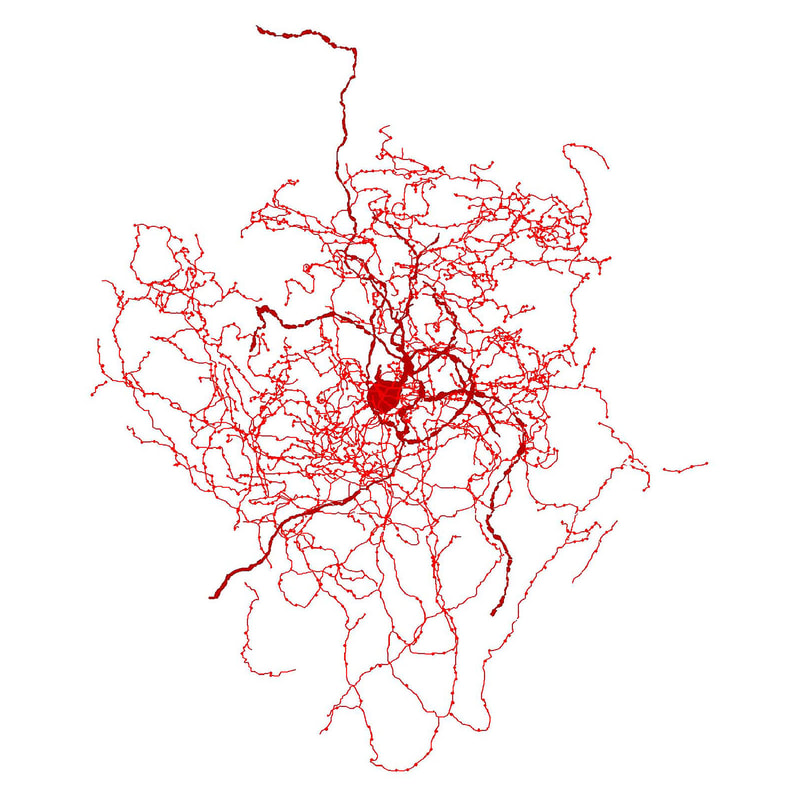
Scientists have discovered a new type of brain cell called the rosehip neuron.  The discovery was made by Ed Lein, Ph.D., Investigator at the Allen Institute for Brain Science and Gábor Tam­ás.  The rosehip neuron may be unique to humans.  It has not been found in mice or other animal species. 
 
What’s distinct about the rosehip neuron is its role as a specialized inhibitor.  Inhibitors put the brakes on certain signals traveling through the brain. The result is a halting of certain actions and behaviors.  Neurons send their signals down the axon of the nerve cell where they release neurotransmitters.  Inhibitor neurons send neurotransmitters to other neurons which inhibit their ability to “fire.”  Further research is needed to determine what specific behaviors are affected by the rosehip neuron. 
 
As I meditated on the discovery of the rosehip neuron, I began to speculate about its role in the disruption of automatic patterns of behavior.  Let’s pretend it’s lunch time but you’ve forgotten to pack a lunch.  Your morning meeting went over and it’s now early afternoon.  You are famished.  You set a diet goal to restrict certain foods.  In the drive thru of your favorite fast-food joint, you consider your options.  Burger or salad?  What makes the difference between choosing a salad or a burger?  Or consider this example.  I was sitting on a couch petting the cat that jumped into my lap.  I was performing the “correct” scratching and petting methods that have proven acceptable to Jorge.  There was purring and stretching.  All was well.  And then he bit my hand.  As I checked to see if I was bleeding, I said to Jorge, “You need to make better choices!”  What does it take to make better choices?  Is the disruption of behavior a human phenomenon or can other animals do it?  What makes the difference?
 
Humans have a unique ability to inhibit automatic behaviors through a thinking system.  Moral codes of conduct, beliefs, values and core principles play a role in guiding one’s behavior.  Several examples come to mind.  The Torah contains the Ten Commandments, which are a list of inhibitors.  The second portion of the commandments declare, “you shall not . . .”  These early laws (including the Deuteronomic Code) have the potential to inhibit certain automatic behaviors.  They command individuals to put the brakes on polytheism, murder, adultery, stealing, lying and coveting. 
 
Similarly, criminal law in the United States is designed to deter certain behaviors.  Sentencing guidelines have the potential to inhibit criminal behavior.  Murder, for example, is organized by degrees and within these degrees are sentencing guidelines for punishment.  Robert Sapolsky in his book, Behave: The Biology of Humans at Our Best and Worst discusses how thinking can influence behavior, but admits that processes that favor automatic behavior are powerful and can be difficult to inhibit.
 
Behavior is a product of the nuclear family emotional process.  This process is passed down the generations creating patterns of behavior to manage anxiety, stress and tension in the family.  These patterns focus the anxiety of the family onto one person.  As anxiety goes up one individual carries the load of anxiety resulting in symptoms.  Symptoms can be physical in nature, psychological and behavioral.  For example, when a family experiences a stressful event, a family member may attempt to manage the tension by organizing the family.  The automatic response of telling others what to do is a behavioral response to the rising level of anxiety in the family.  In reaction to the effort to organize the family, others may ignore the commands, become combative or give in and comply.  These responses are automatic and reactive because the thinking system in the brain is largely not involved.  It is for all intents and purposes offline.  Blaming someone for the way they automatically manage stress misses the point that everyone in the family plays a party in how one behaves.  One can make a difference in the way they behave, but only when the effort is to work on self.
 
Differentiation of self is the first step in learning how to put the brakes on automatic, reactive responses to chronic anxiety in the family.  The process begins by observing the "who," "what," "where," "when" and "how" anxiety flows through the family.  What follows are incremental steps towards understanding how one picks up or passes along the anxiety, discovering more responsible ways for responding to anxiety in self and in others and developing a broader capacity to engage one’s thinking in the midst of anxious others and self. 
 
Perhaps one day scientist will discover the neuronal pathways that lead to better functioning for individuals and for families.  It may be that inhibitor neurons play a role in toning down anxious signals by way of higher-level processing.  Until we have all the facts we use theories like Bowen family system theory, beliefs and core principles to guide our thinking and behavior.
Subscribe to receive the newest blog in your inbox every Monday morning.

SUBSCRIBE
2 Comments

How Culture And, Yes, Biology Are Impacting Humans

9/9/2018

0 Comments

 
Picture

What influences human behavior?  And why is there so much variation?  Is it biology or culture?  We are born with biological systems (circulatory, digestive, endocrine, exocrine, immune, lymphatic, muscular, nervous, reproduction, respiration, skeletal, and excretory) that are authored by DNA and were set in motion a long time ago.  Culture includes things like psychological framework, perceptions, beliefs, language, biases, and rituals.  DNA is transcribed through a biological process.  Culture is transmitted through a relationship system.  The interplay of biology and culture materializes in the epigenome where DNA is regulated in response to an ever-changing culture.  These epigenetic changes are passed on from one generation to the next.  What exactly is being passed along in this mix of biology and culture?  It is the collective ability of the human to adapt and be flexible in the face of challenges.
 
Dr. Murray Bowen’s concept of the family emotional process includes the basic life forces of togetherness and separateness (individuality).  The togetherness force in the family, and in larger relationship systems, shapes the culture.  The force for togetherness moves people to participate in the family and larger group experiences (culture) through common feelings, thinking, and behavior.  Bowen observed that as anxiety increases in the family unit, the force for togetherness also increases.  In response to this increase, there are two predictable reactions.  One reaction is the rebellious response which pushes back against the family.  It can include the refusal to participate in the cultural ethos.  Others respond by doubling down to demand, from within the family and the broader culture, more adherence to cultural expression.  These reactions to increases in anxiety are automatic which means there is a biological component.  
 
Congregations of different faiths have been struggling with the cultural push back against organized religion. It is possible that the cultural shifts that have led to a decline in religious expression and an increase in cases of isolation may have something to do with the interplay of biology and culture.  As humans adapt to a changing environment, current cultural expressions of beliefs and practices are no longer serving the purpose of adaption.  In other words, the current demands on human biology are leading to new adaptive ways of thinking and believing which are leading to a change in cultural expression.  So, a new way of thinking (a shift in beliefs and culture) is needed if humans are to move forward.  This is the current struggle facing religion.
 
Must we give up all religious beliefs and practices?  That’s hardly the case when you consider how useful some beliefs and practices have been to billions of people over thousands of generations.  However, belief and practices need to continue to adapt and shift just as they have for thousands of generations.  People are hungry for a redefining of culture and cultural expression.  Congregations are looking for ways to redefine beliefs and religious expressions.  They are looking for a system of beliefs and practices that are useful to the challenges people are facing.  This is an adaptive process this is both biological and cultural.  Congregations who are examining the challenges they face are engaging new, creative practices that will eventually rewrite our cultural narrative, and impact our biology all the way down to our DNA for generations to come.  No one has figure it out, although it is certainly not from a lack of effort.  The answer will one day explode onto the cultural scene.  How is your faith community adapting and developing beliefs and practices that help individuals and families adapt to change?
Subscribe to receive the newest blog in your inbox every Monday morning.

SUBSCRIBE
0 Comments

#ChurchToo

8/19/2018

0 Comments

 
Picture

Earlier this year, Bill Hybels, the founding pastor of the megachurch Willow Creek in South Barrington, IL, resigned ahead of his planned retirement.  The early departure was in response to allegations of sexual misconduct.  Earlier this month, it was reported that Willow Creek Church settled a separate case of sexual abuse for $3.2 million after a volunteer sexually assaulted two disabled children.  And then last week, a grand jury released its findings that over 1000 children were sexually abused by over 300 priests in six Roman Catholic dioceses in Pennsylvania. 
 
These revelations are difficult to read.  All of it is unacceptable at an individual and institutional level.  I struggled this week reconciling my feelings of outrage and frustration with my beliefs and the facts of human behavior.  This blog represents my effort to “think” about the problem of sexual abuse.
 
It’s difficult to engage one’s thinking about an emotionally “charged” problem when people use words like “shocked,” “ashamed” and “disgusted.”  Even the effort to articulate an emotionally neutral understanding of this behavior is dismissed as dispassionate.  We are right to hold individuals and institutions accountable for abuse.  But is there a better way to respond besides blame and disgust?
 
Dr. Murray Bowen developed a concept of emotional neutrality that focused on seeing the world as it is, not how one might wish for it to be.  Dr. Michael Kerr wrote that emotional neutrality, “is broadened each time a human being can view the world more as it is than as he wishes, fears, or imagines it to be” (Family Evaluation, 111).  So, what can we view about human behavior?
 
The assumption in Bowen Theory is that human behavior is both automatic and reactive.  While we like to think that all behavior is intentional, we can get stuck reacting to others.  How we feel, think and act is in response to the feeling, thinking and action of others.  Even our thoughts can be reactive to our feelings.  Bowen described this as fusion.  The level of fusion in a family is passed down from generation to generation through a multigenerational transmission process.  This is the way a family learns to manage anxiety.
 
Anxiety drives the process.  We carry around a specific level of chronic anxiety that mirrors the level in our family.  The level of anxiety impacts the level of functioning.  The higher the anxiety, the lower the level of functioning and vice versa.  Fluctuations in anxiety are in response to the family’s response to a challenge.  As anxiety rises, human behavior becomes automatic.  One example of this is alcoholism.  As anxiety goes up, one reaches for a drink as the functional level declines.  But few alcoholics drink 24/7/365.  “Functional alcoholics” fluctuate between drinking moderately and drinking excessively.  Variation in functioning occurs in the context of the family in real time.  Bowen describes this variation in his scale of differentiation.
 
Addressing the problem of sexual abuse is complicated.  Each person plays a part in the level of anxiety in the family and therefore the functional level of each person.  Most people can improve their functional level by regulating their anxiety and reactivity.  Leaders work at containing their anxiety and being responsible for their behavior.  Being more responsible requires an ability to see what is.  Bowen outlined these ideas in his concept of differentiation of self.
 
It is time for us to change the way we address sexual abuse based on an understanding of differentiation.  Our training, resources, policies and procedures need to reflect human behavior as it is, not how we wish, fear or imagine it to be.  Congregational leaders can take the lead by having more open communication about the problem and wade into what may be difficult waters.  The best place for a leader to start is in conversation with one’s family.  We have finally arrived at the real challenge and opportunity.
 
It is far easier to point the finger at the inability of others to manage their behavior while at the same time excuse our behavior.  It is easier to be disgusted by the sexual abuse of others and not understand how we are all on the same continuum of human functioning.  It is easier, and frankly feels better, to be outraged at the problems of the institutional church then it is to commit to making changes for self in relationship to important others.  If you want to address bad behavior in the congregation, then it is best to start with oneself, one's relationship with the family and one's relationship with the congregation.  Differentiation of self is the place to begin.
Subscribe to receive the newest blog in your inbox every Monday morning.
SUBSCRIBE
0 Comments

Koinonia - Part 5: Addressing Bad Behavior

8/5/2018

0 Comments

 
Picture

Abuse of any kind destroys efforts to build community.  The abuse of a child, sexual abuse between adults, violent actions or the misuse of money can be devastating to a congregation.  Some congregations do not survive the bad behavior of one or two people. 
 
Bill Hybels, of Willow Creek Church, has been accused of sexual misconduct by several women, which he denies.  The New York Times just published a piece about one of the women, Pat Baranowski.  Time will tell if and how Willow Creek will survive the revelation of Mr. Hybel’s bad behavior. 
 
Many factors contribute to the sustainability of a congregation after they experience abuse and violence.  I’ve written several blogs about understanding bad behavior in the context of congregations and families:
 
Bad Behavior
How Changing Your Behavior is Like Using The Accelerator and Brake
Change Your Life in Less Than A Second
Violence In Society
Angels and Devils
 
Robert Sapolsky, in his latest book Behave, explores the systems that influence behavior.  He traces behavior back to days, weeks, months and even years before it occurred.  What may have happened in an instant has been in the works for multiple generations.
 
Dr. Murray Bowen discovered a connection between chronic levels of anxiety in the family and automatic behavior.  The higher the level of chronic anxiety in a family system, the more likely the behavior of individuals in a family will be automatic and predictable.  The specific nature of the behavior depends on patterns in the family – the way anxiety is managed in the family over several generations.  These patterns fall along a continuum of human functioning.  Bowen described it in his scale of differentiation. 
 
In the Gospel of John, there is a story of a woman caught in adultery.  She is surrounded by a crowd ready to stone her.  Jesus kneels next to the woman and basically says to the crowd, “If you have never broken the law, throw your stone.”  Placing human behavior on a common continuum of functioning disrupts automatic patterns of blame and punishment and provides avenues for the restoration of individuals and relationships.
 
In my series on #koinonia, building community, I make the case that efforts to create safer communities by excluding people based on behavior is antithetical to building community.  Welcoming, accepting and including individuals in responsible ways create safer and healthier communities.  Christians refer to this as the work of the Holy Spirit who heals, transforms and makes people whole through the church (the gathered community).
 
Many congregations are advocating for legislation like The Sentencing Reform and Corrections Act of 2017.  It is a bipartisan bill that advances the need for reforms in reentry provisions and sentencing.  It addresses mandatory minimums, three strike laws with life sentences and looks at laws that target vulnerable communities.  Restorative justice, not retribution, makes communities safer and healthier.  Individuals do better not when they are isolated because of the behavior but when a community responsibly engages the person who is behaving badly.  It is the process of engagement within the context of a relationship system that individuals step up and do better.  What makes the difference?  It is differentiation of self. 
 
Congregations that move forward in the midst of abuse and violence are led by spiritually mature persons.  A spiritually mature person is one who works on being clear about their beliefs, discerns a life direction based on an understanding of call and is responsible for ongoing participation in religious practices.  It is someone working on differentiation of self.  People do better in congregations that, instead of requiring blind obedience or obligatory participation, focus on supporting individuals to self-regulate their personal expression of religious faith. 
 
A focus on being responsible for self, including the self-regulation of behavior, requires the engagement of the prefrontal cortex and other brain systems.  These thinking systems disrupt the automatic patterns of behavior that are shaped by a multigenerational transmission process. 

​Congregations are not hopeless in the face of bad behavior (abuse, violence, theft, etc.) but can move forward based on principles and good thinking.  Clergy and congregational leaders can lead the way as they work on differentiation of self in their families. 
Subscribe to receive the newest blog in your inbox every Monday morning.
SUBSCRIBE
0 Comments

Angels and Devils

6/17/2018

1 Comment

 
Picture

I recently played the disciple Judas in a performance that brought to life da Vinci’s famous painting, The Last Supper.  Spoiler alert: Judas betrays Jesus.  Some people in my congregation experienced cognitive dissonance as they watched their pastor portray Judas.  During the meet and greet after each performance, the audience processed through the cast line, shook hands and took selfies with Jesus (and the other disciples).  People walked past me with no hand shake or selfie.  Or I should say, they walked past Judas.  I can’t blame them, though.  Don’t we all dislike Judas?  He's the one to blame, right?
 
Judas represents the worst of human behavior: betrayal.  For some, betrayal is an unforgivable sin.  Still, there are those who make attempts to forgive in the face of betrayal.  Forgiveness is a messy word.  Some refuse to forgive as a matter of principle and conviction.  To forgive would be to give in or give up.  Others proclaim that forgiveness provides an experience of freedom.  Forgiving others or forgiving one’s self has set them free.  What really drives the decision to forgiven?  It is the emotional process.
 
The emotional process describes how the behavior of others influences one’s behavior and vice versa.  It’s a reciprocal process, and it’s predictable, like a script.  If I say or do “x,” then someone else will predictably do “y.”  Because this is a system view, multiple people play a part in how each person behaves.  For example, the family functions as an emotional unit.  Whether or not one forgives is largely based on a family script of emotional process.  The family script is handed down from generation to generation.  Going back and understanding one’s family from a multigenerational perspective sheds light on how the emotional process works in one’s family of origin.  It can help an individual within the family move out of automatic, predictable reactivity to a more thoughtful, principle orientated response. 
 
Dr. Murray Bowen wrote:
 
More knowledge of one’s distant families of origin can help one become aware that there are no angels or devils in a family; they were human beings, each with his own strengths and weaknesses, each reacting predictably to the emotional issue of the moment, and each doing the best he could with his life course. 
Family Therapy in Clinical Practice 492.
 
 
I like portraying Judas because he challenges my automatic tendencies to see angels and devils in my family.  Judas was human and reacted to the emotional issues of his day.  Jesus even predicts his response.
 
It’s difficult to define what love is both from a scientific perspective and from a religious perspective.  What we do know is that if we receive too much of it or not enough, we become reactive. Perhaps a faith-based definition of love is that we are all children of God and we are enough.  It reminds of what Bowen stated that everyone is doing the best they can with what they have.  Engaging the emotional process is about accepting others and challenging self.    
 
Differentiation of self includes an effort to define one’s relationships.  What kind of relationship do you want to have with your mother, father, siblings, etc.?  How do you think about the relationship?  What’s important to you about the relationship?  We pretend that we are defining our relationships through things like politics, religion, social views, whether someone is adding to one's life.  In reality we end up defining our relationships not by feelings (love), or by thinking (definitions) but instead by an emotional process: are you making my life easier or more challenging?  In this way, our relationships get defined by the moment to moment reactivity that is in the family system.  Differentiation of self consists of acknowledging the feelings associated with a relationship and then taking actions based on one’s beliefs and principles.  It’s about knowing the difference between feelings and thinking.
 
What are the factors that influence a relationship status?  They include the level of chronic anxiety in the relationship system, the current level of challenge or calm in the family, the capacity of individuals and the family to access resources to address a challenge, the number of viable emotional connections that are available at the time, and one’s belief about the nature of relationships.  As one works on differentiation of self, there are no longer angels or devils in the family or the congregation.  Instead, we discover that human beings are doing the best they can with what they have.  And I, for one, can always do better.
Subscribe to receive the newest blog in your inbox every Monday morning.

SUBSCRIBE
1 Comment

3 Ways We Are Motivated And Why It Matters

6/10/2018

0 Comments

 
Picture

If you lead a volunteer organization, your biggest challenge is not money.  Your biggest challenge is finding motivated volunteers.  And by motivated, I mean motivated to be responsible. 
 
Congregations are structured by committees.  Committees are lead by volunteers who support the mission of the organization.  But not every volunteer is motivated to do the work.  So, congregations are often a mix of committees where some function at a higher level while others struggle to accomplish their objectives.  What makes the difference?  It is the motivation of the volunteers. 
 
There are basically three ways people develop motivation.  The first two are about external motivating factors.  We all find motivation and inspiration from other people.  People who are charismatic can often motivate the unmotivated.  This is why charismatic leaders are so popular.  The second way people are motivated is when they become uncomfortable with the way things are.  If one is uncomfortable with the direction (or lack thereof) of an organization, they become motivated to make things better.  Like the first example, this is an external motivator because the motivation is based on a perceived assessment of the organization. 
 
Dr. Murray Bowen observed this external process of motivation in the family.  He described it as an over/under reciprocity or over/under reciprocal functioning.  The basic idea is that behavior occurs reciprocally in a relationship system or emotional unit (like the family).  Bowen observed that one spouse will overfunction, and the other spouse lets them overfunction.  The more one does for the other, the less the other does for them self.  These same patterns are extended to other relationship systems.  If one’s tendency is to underfunction in the family, they will more than likely bring this same pattern to the congregation.  If a leader underfunctions on a committee, others on the committee may find themselves taking on more responsibility (doing the things that leader can do).  If a leader overfunctions in the family, in the committee they may take on more responsibility than is needed. 
 
It’s helpful to note that anxiety drives this reciprocal process of over/underfunctioning.  As one becomes consumed with worry and fear, other picks up the anxiety and each person shifts into doing either more or less.  The reactivity to anxiety to do more or do less is the product of a multigenerational family emotional process.  In a way, one learns these patterns from one’s family of origin over the generations.  The reactivity is automatic in the sense that very little thinking and awareness go into this response.  It just happens.
 
The third example of motivation is what Dr. Bowen identified in the concept of differentiation of self.  When an individual is clear about core principles and a life direction, they are motivated to do the work.  It is an internal motivation because it comes from within the self.  This type of motivation is not determined by the motivation (or lack of motivation) of others but instead is based on a clear understanding of one’s beliefs and direction.  The focus of this type of motivation is less on others and more on self.  However, it is not selfish.  In fact, this type of motivation enables one to be more available to others. 
 
In congregations, some people use the word motivation and calling interchangeably.  To find motivation is to rediscover one’s calling into ministry.  Again, one's “calling” can be caught up in the reciprocal back and forth process of the relationship system.  One might feel called in response to what others are doing or not doing.  A true calling is something one pursues with or without others.  Leadership can be lonely.
 
When an organization is full of motivated people, the work they do together is less complicated.  When I think back on the many years my kids played soccer, it was easy to tell which kids were motivated to play.  The motivated kids excelled and were able to step up when challenged.  Less motivated kids depended more on the coach.  They did not excel as quickly.  A good coach can tell which players are motivated and then knows how to both motivated and train their players.  In a congregation, a pastor can tell who is motivated and who needs to be motivated.
 
The congregation I serve created a new process to identify motivated leaders.  If someone is interested in serving on the top leadership team, they must go through an application process.  Applicants fill out a form and provide written answers to questions.  The questions are designed to help an applicant reflect on their motivation for serving, consider their gifts and talents, and discern if they are called to be on the leadership team.  Once the application is completed, applicants are then interviewed. 
 
For many years, the process of filling a volunteer leadership position in the church was accomplished by externally motivating people to serve.  It’s sometimes referred to as arm twisting.  The result often left unmotivated individuals sitting in positions of responsibility accomplishing very little.  This new process addresses the problems with motivation.  Is this person applying for a leadership position because the congregation needs someone in that position or because the individual is self-motivated to do the work?  And if they are motivated, is it because the work is important to them or because they are anxious and worried about the organization?  The answers to these questions can have different outcomes.
 
The ideal candidate for a volunteer position in the church is someone whose personal goals, beliefs, and life direction is in line with the congregation's goals, beliefs and direction.  There may be differences over the details.  But in general, what is important to the individual is important to the congregation.  In this way, the calling (and motivation) of the individual supersedes the needs of the organization.  The individual will pursue what motivates them whether the congregation accepts them as a volunteer or not.  One could make the case that a thriving congregation is simply a collection of individuals who are self-motivated to pursue their calling in life.  And to that, I say Alleluia!  Amen!
Subscribe to receive the newest blog in your inbox every Monday morning.

SUBSCRIBE
0 Comments

Change Your Life in Less Than A Second

3/18/2018

3 Comments

 
Picture

When it comes to behavior, do we have a choice or is it automatic?  It turns out that our behavior is more automatic than we’d like to admit.  Way more.  But we are not always at the mercy of automatic behavior.  We can do something about it.
 
New research out of Johns Hopkins University suggests we have about a half a second to stop our automatic behavior.  It takes approximately a half a second for signals from a sensory organ (like the eyes) to be sent and processed by the brain and for a subsequent signal to be sent to a muscle.  So, yes, there is potential for choice when it comes to behavior, but the window is small.  It is a half a second small.  With the challenge set before us, there are steps one can take to disrupt automatic responses.
 
If we think of the brain as made up of multiple systems, there are at least two important systems that influence behavior.  There is an emotional system which includes all of our automatic behaviors.  For example, the regulation of the body and the natural ability to be social.  When someone smiles at you, it’s likely you will automatically smile back.  Try it today.  Smile at people and see if they smile back.   That's the emotional system at work.
 
Another system is the thinking system.  This includes the prefrontal cortex and other structures that influence the expression of a self.  For example, having one’s own thoughts, feelings and actions is an expression of self. 

Anxiety affects how these two systems operate.  When anxiety is high, it can undermine the thinking system in favor of the automatic, emotional system.  That’s not always a bad thing, especially if one is in imminent danger.  It also works the other way.  The thinking system can override reactive, automatic behavior which results in a decrease in anxiety.
 
Why does this matter?  Well, let’s say you are the leader of a committee.  You dread having to lead this particular committee.  A couple of people are creating problems for the group.  You have an automatic way of addressing the behavior.  While your automatic response may have initially made a difference, it no longer works.  In fact, the problem is getting worse.  The meetings are tense, and you can feel the tension in your body before the meeting starts.

One can disrupt one's automatic response by engaging the thinking system.  While we may only have a half a second to change course, in the heat of the moment, you really can’t do much of anything.  So, to make good use of that half a second, one needs to step back and strategies how one wants to behave. 

So, let's take the previous example and start from the beginning.  Someone says something in a particular tone and in a particular manner, and you are off to the races.  How can one prepare to not react automatically and behave differently?  The preparation includes the following:

  1. Identify the trigger.  Is it the words, the tone of voice, the level of intensity or a particular body movement?
  2. What happens to me internally?  What do I feel, think, and want to do?
  3. What do I do automatically in response to the trigger?  Do I say something, do something, walk away or shut down?
  4. What does a mature response look like?  How many alternative options can I come up with?  (Hint, there is always more than one option.)
  5. What will it take to disrupt my automatic response and respond with thinking?
  6. How do I predict others will respond to my thinking?
  7. What will my response be to the automatic reactivity of others?
 
We can also use this approach with the family.  Again, we don’t like to admit it but our behavior towards the family is mostly automatic and at times reactive.  It is not a bad thing to react automatically to one’s family.  When a baby is hurt and starts to cry, mom and dad move towards the baby and pick it up.  It’s what we do.  The problem comes when an automatic response creates additional problems.  For example, when the baby learns to cry to be picked up. 
 
Where do our automatic responses come from?  They have their origins in past generations.  A specific behavior may have started in your great-grandparent's generation or in a previous generation.   The dance of automatic patterns between spouses, parent and child, and siblings have been passed down from generation to generation, a process Dr. Murray Bowen called the multigenerational transmission process.  Recent discoveries in epigenetics have confirmed that how one responds to a particular life challenge is passed on to the next generation.  These responses become automatic behaviors in subsequent generations.  The good news is that it is possible to redirect one's behavior away from these automatic, generational patterns of reacting and shift one's behavior towards differentiation of self. 
 
So, as you prepare to take advantage of that half a second you have between doing what comes automatically and deciding to do something different, consider the following questions:

  • What am I trying to accomplish with my life?  What are my life goals?  What is my purpose and mission in life?
  • What is a core belief I can use to guide my thinking?
  • What can I do to calm down when I’m anxious? What can I do when I feel all revved up inside? What can I do when everyone else around me is revved up?
  • What does a more responsible version of myself look like?
 
What questions or opportunities for thinking can you add to this list?
Subscribe to receive the newest blog in your inbox every Monday morning.
SUBSCRIBE
3 Comments

    Author

    John Bell is the thinker behind Thinking Congregations.  As a thought partner he believes the best way forward is for leaders to do their best thinking.

    Subscribe!
    Click here to receive the blog by email. 

    Archives

    February 2020
    April 2019
    March 2019
    February 2019
    January 2019
    December 2018
    November 2018
    October 2018
    September 2018
    August 2018
    July 2018
    June 2018
    May 2018
    April 2018
    March 2018
    February 2018
    January 2018
    December 2017
    November 2017
    October 2017
    September 2017
    August 2017
    July 2017
    June 2017
    May 2017
    April 2017
    March 2017
    February 2017
    January 2017
    December 2016
    November 2016
    October 2016
    September 2016
    August 2016
    July 2016

    Categories

    All
    Beliefs
    Change
    Chronic Anxiety
    Community
    Conflict
    Death
    Differentiation
    Emotional System
    Fear
    Individuality
    Leader
    Meeting
    Motivation
    Multigenerational Transmission Process
    Observing
    Over Functioning
    Process
    Projection
    Regression
    Togetherness
    Training
    Transition
    Triangle
    Under Functioning
    United Methodist
    Vision

    RSS Feed

Services

Blog
Coaching
Events


Company

About
Contact
© COPYRIGHT 2015. ALL RIGHTS RESERVED.