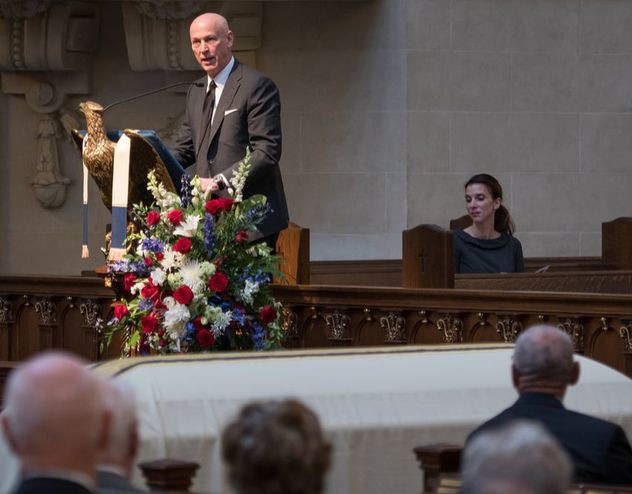
Clergy and congregational leaders play an important role in supporting families before a funeral. There is variation in the way families prepare for a funeral service. Some families need more support than others. When someone dies, families have an opportunity to step up their level of functioning. Clergy can learn to do a better job of managing their anxiety and not overfunction for others.
I see variation in the ability of families to plan a service. Some families, because of the leadership of one or two individuals, have a clear idea of what needs to happen and are open to the ideas of others. On rare occasions, the one who dies leaves behind ideas for the service. Other families struggle to pick hymns and scripture readings. When families struggle, it’s tempting for clergy to overfunction.
My practice (when meeting with the family to plan a service) was to invite family members to tell stories about the person who died. This experience, common for most clergy, was therapeutic for families and provided me information for the sermon. As one family member after another talked, I’d take copious notes of the stories, themes, and images they shared. By the end of the conversation, I’d gathered enough information to give a sermon and a eulogy. My notes would include important life principle, beliefs and favorite activities. Some family members would volunteer to speak. But most families were fine with me pulling it all together for them. Back at the office, I’d work my preaching magic to weave together a meaningful and memorable message about the person’s life. I was really good at it.
A few years ago, I faced the reality that I was sharing stories about people I didn’t know personally. It’s common for pastors to preside over the funeral of someone they don't know. People don’t wait for you to get to know them before they die. Although in one congregation, a member insisted I meet her the week I arrived because she was convinced she was going to die. She did not want a stranger officiating at her funeral! She lived for many more years and was still alive when I left. Sometimes clergy are invited to officiate at the funeral of a spouse of a member who didn’t attend church. I addressed these realities by being clear about my relationship to the person and acknowledging that there are family and friends who knew them better than I did.
Eventually, I came to the realization that in my sermon/eulogy I was telling stories that belonged to other people. The stories were their stories to tell, not mine. So, I quit this practice. I began to invite family members to speak at the funeral service. The response was varied. Then and now, their responses fall into two categories.
In the first category, families can identify with ease individuals to speak. In the other group, families struggle to find one person to give a eulogy. I encourage families to find at least one person to speak about their relationship with the person who died. More if possible. People vary in how they use their time. Some people talk directly about their relationship with the person who died. They share experiences and insights into the relationship. Other people become a “spokesperson” for the family, collecting stories and experiences to share. That was the role I stopped playing.
For my part, the focus of my sermon is to articulate what I know and don’t know about death and the mysteries of life. If I have a relationship with the person who died, I talk about it but avoid making comments from other relationship angles. The sermon includes observations of the strengths of the family as they come together to support one another. I speak about the intersection of faith, life and death with an effort to be as clear as I can. Each funeral is an opportunity to clarify these things and to learn how to sit with questions and the mysteries of life.
My observation after doing this project for several years is that families do better, especially family members who stand up and speak about their relationship with the person who has died. Speakers have little trouble making it through the service. There is some variation but, in general, it’s true. One might want to debate that those who agree to speak already have the capacity to speak. I’ve observed individuals, who were resistant to speaking, even struggling for a day or two with what to say, come around and speak at the funeral with what I would call ease. I originally found this observation to be counter-intuitive.
Funerals have new meaning for me. They are an opportunity to define a self. Inevitably families push back at the invitation to speak. Some resist and try to pressure me into reading what other people write, asking me to be the spokesperson for the family. I evaluate these requests on a case by case basis. There have been times, not very often, when I’ve agreed to it when the circumstances call for it. Typically, though, families can identify at least one person (sometimes in the extended family) who will speak about their relationship with the person who has died. My observation is that families get more out of these eulogies.
The shift in my focus has been a worthwhile challenge. When I don’t know the person who has died (and so I don't speak about them), it’s an opportunity to clarifying my thinking about death and dying which has not been easy. I can do a good job pretending I know something about death. Opportunities to think about death, life, faith and relationships have given me a place to stand as I engage my family about these important issues.
At the end of the day, it’s about responsibility. What is a pastor or congregational leader responsible for at a funeral? How do clergy overfunction in the face of the anxiety and grief in a family? How does overfunctioning undercut the functioning of others during the grieving process? What are the benefits and challenges of being clear about what one is willing to do and not willing to do? These are questions I’ve considered? What questions come to your mind?
I see variation in the ability of families to plan a service. Some families, because of the leadership of one or two individuals, have a clear idea of what needs to happen and are open to the ideas of others. On rare occasions, the one who dies leaves behind ideas for the service. Other families struggle to pick hymns and scripture readings. When families struggle, it’s tempting for clergy to overfunction.
My practice (when meeting with the family to plan a service) was to invite family members to tell stories about the person who died. This experience, common for most clergy, was therapeutic for families and provided me information for the sermon. As one family member after another talked, I’d take copious notes of the stories, themes, and images they shared. By the end of the conversation, I’d gathered enough information to give a sermon and a eulogy. My notes would include important life principle, beliefs and favorite activities. Some family members would volunteer to speak. But most families were fine with me pulling it all together for them. Back at the office, I’d work my preaching magic to weave together a meaningful and memorable message about the person’s life. I was really good at it.
A few years ago, I faced the reality that I was sharing stories about people I didn’t know personally. It’s common for pastors to preside over the funeral of someone they don't know. People don’t wait for you to get to know them before they die. Although in one congregation, a member insisted I meet her the week I arrived because she was convinced she was going to die. She did not want a stranger officiating at her funeral! She lived for many more years and was still alive when I left. Sometimes clergy are invited to officiate at the funeral of a spouse of a member who didn’t attend church. I addressed these realities by being clear about my relationship to the person and acknowledging that there are family and friends who knew them better than I did.
Eventually, I came to the realization that in my sermon/eulogy I was telling stories that belonged to other people. The stories were their stories to tell, not mine. So, I quit this practice. I began to invite family members to speak at the funeral service. The response was varied. Then and now, their responses fall into two categories.
In the first category, families can identify with ease individuals to speak. In the other group, families struggle to find one person to give a eulogy. I encourage families to find at least one person to speak about their relationship with the person who died. More if possible. People vary in how they use their time. Some people talk directly about their relationship with the person who died. They share experiences and insights into the relationship. Other people become a “spokesperson” for the family, collecting stories and experiences to share. That was the role I stopped playing.
For my part, the focus of my sermon is to articulate what I know and don’t know about death and the mysteries of life. If I have a relationship with the person who died, I talk about it but avoid making comments from other relationship angles. The sermon includes observations of the strengths of the family as they come together to support one another. I speak about the intersection of faith, life and death with an effort to be as clear as I can. Each funeral is an opportunity to clarify these things and to learn how to sit with questions and the mysteries of life.
My observation after doing this project for several years is that families do better, especially family members who stand up and speak about their relationship with the person who has died. Speakers have little trouble making it through the service. There is some variation but, in general, it’s true. One might want to debate that those who agree to speak already have the capacity to speak. I’ve observed individuals, who were resistant to speaking, even struggling for a day or two with what to say, come around and speak at the funeral with what I would call ease. I originally found this observation to be counter-intuitive.
Funerals have new meaning for me. They are an opportunity to define a self. Inevitably families push back at the invitation to speak. Some resist and try to pressure me into reading what other people write, asking me to be the spokesperson for the family. I evaluate these requests on a case by case basis. There have been times, not very often, when I’ve agreed to it when the circumstances call for it. Typically, though, families can identify at least one person (sometimes in the extended family) who will speak about their relationship with the person who has died. My observation is that families get more out of these eulogies.
The shift in my focus has been a worthwhile challenge. When I don’t know the person who has died (and so I don't speak about them), it’s an opportunity to clarifying my thinking about death and dying which has not been easy. I can do a good job pretending I know something about death. Opportunities to think about death, life, faith and relationships have given me a place to stand as I engage my family about these important issues.
At the end of the day, it’s about responsibility. What is a pastor or congregational leader responsible for at a funeral? How do clergy overfunction in the face of the anxiety and grief in a family? How does overfunctioning undercut the functioning of others during the grieving process? What are the benefits and challenges of being clear about what one is willing to do and not willing to do? These are questions I’ve considered? What questions come to your mind?
Subscribe to receive the newest blog in your inbox every Monday morning.
 RSS Feed